Showing posts with label Press. Show all posts

Saturday, March 09, 2019

For The Day After

EN ES

Lluis Foix
Spanish journalist and writer, specialized in international politics.

6/3/2019 La Vanguardia


ENGLISH
In the harshest years of the cold war there was a joke in Budapest in which someone asked what is the worst thing about communism, and the answer was "what comes next". The future is invented and fear is not usually formed by the misfortunes or concerns of the present, but from the uncertainties of the future.
In his chronicles about the falsification of history, the Italian historiographical essayist Paolo Mieli recalls how, at the end of 1943, when the Germans sensed that they may be defeated, a phrase was spread in Germany that was like a premonition: let's enjoy the war because peace will be terrible. And it was not just in defeated Germany, but also in Europe, as it was strewn with corpses and destroyed, morally and materially.

Each era has its own version of the past, looking for that slant that best suits current policies. There is more talk about historical memory than about historical truth, as the cultural activist Albert Manent liked to mention. The historical truth sticks to the mistakes and successes of all parties at all times without trying to repeat situations that are entirely different.

It was Manent himself, militant nationalist and faithful to Jordi Pujol (President of Catalonia from 1980 to 2003), who in the last months of his life, he died in 2014, told me that in order to avoid the frustrations that had so often shaken Catalan society and politics, you must: do things in time, master the calendar and foresee the consequences of the actions taken in any decision of public nature.

We are in full turmoil; with a trial in progress involving half of the previous Catalan Government, with the usual struggles and backstabbings to make the lists in the Spanish electoral system to choose the members for Congress, Europe, municipalities and communities where parliaments are renewed. We will arrive in the summer and the political map may have turned upside down or, in any case, it will be very different.

You have to prepare for the day after, in Europe, and in Spain and Catalonia. In the European Parliament, according to the polls, extremism is going to increase, more from the right than from the left, which no longer want to destroy the European Union but to change it in questions of principles that affect the dignity of the people and respect for those who think differently. Democracy must protect minorities.

Whatever the outcome of the afore mentioned elections that will take place up to the 26th of May, Spain and Catalonia will need to find a common ground that will restore as much confidence as possible within the discrepancies and disaffection that are here to stay for a very long time. Whatever the judgments of the trial, what has happened since Artur Mas (president of the region of Catalonia from 2010 to 2015) became pro-independence hasn't been positive. Whom can settle the chaos present in Catalonia; a president who depends on another one that is self-exiled in Waterloo (Brussels), several ex-members of his government on trial, plus two social leaders also prosecuted, a few self-exiled politicians and a parliament that is practically inactive? I think no one, not even those who have grown exponentially in Catalan politics as a result of collecting hundreds of thousands of anti-independence votes.

The leaders of the Process will have to accept that things have not gone well in Catalonia and that continuing with the confrontation with the Spanish state won’t lead anywhere. It has not had the support of Europe or the Western democracies, it has not achieved a sufficient social majority needed to take the steps in order to break with Spain and, above all, as is being demonstrated in the trial, there was a firm plan that enabled them to carry breaking up with Spain with a minimum of guarantees. The State will also have to admit that it did not know how to politically manage a conflict that couldn't end up in the courts.

Rajoy did not think that the separatists would go as far as they did, and the Catalan sovereignty aims did not calculate that Spain would react with all the instruments at its disposal to avoid a unilateral secession. People with as much legal experience as the former member of the Constitutional Court, the pro-secessionist and strategist Carles Viver Pi-Sunyer, knew that the famous white book promoted by him had nothing to do with some sort of formula for the disconnection of Francoism, law by law, that was intended to be promoted in Catalonia. It was hoped that Europe would opt for Catalan independence, thinking that the breakdown of legality would be accepted by the pressure of the multitudinous demonstrations.

The first thing that should be done in the day after, in my opinion, is to restore the internal complicities in Catalonia so that, at least, the institutions function with shared rules of the political game. It is also necessary to return to the Parliament the function of being the center of the national debate. Crises are discussed and resolved in Parliament, as it's being demonstrated these days in Westminster. See, in short, what's the place of Catalonia in Europe and in the world knowing that, today, its unilateral rupture is impossible. Borrowing the title The Conspiracy Of The Irresponsable, from the book of Jordi Amat, we must flee from useless acts, although they may seem heroic.

ESPAÑOL

Para el día después

https://www.lavanguardia.com/opinion/20190306/46872270558/para-el-dia-despues.html


Share:

Viver Pi-Sunyer's hypocrisy: from denying everything before the judge to fanning the independence dream

EN ES

Laura Fábregas
12/1/2019 Crónicaglobal

ENGLISH
The former president of the (Catalan) Advisory Council for the National Transition was the one who orchestrated the reports on the so-called '(Catalan) State structures', but before court he denies any involvement in the (Catalan pro-independence) 'process'

The former magistrate of the Constitutional Court and former president of the Advisory Council for National Transition (CATN), Carles Viver Pi-Sunyer, received on Thursday the Gold Medal of the Generalitat (Catalan regional government), the highest honorary distinction awarded by the (Catalan) Government to personalities known for their public work . The jurist took this opportunity to predict the independence of Catalonia by ensuring that he sees it possible for the Catalan region to "successfully complete" its path to secession.

These statements are a far cry from what he declared during the oral hearing for his alleged involvement in the consultation (on the independence of Catalonia) on November 9, 2014, when he categorically denied his participation in the "participatory process" promoted by the former president of the Generalitat Artur Mas. "There is a legend about my work that does not correspond to reality," he argued before the courts to try to avoid any civil liability. In the same vein, Viver Pi-Sunyer downgraded the relevance of an organ which was created with great fanfare, the CATN, stating that "in reality he was just a legal advisor to the (Catalan) Government".

Architect of Independence

Nothing could be further from the truth. Members of the (Catalan) Government and leaders of the pro-independence process ("process") call it the main provider of legal material to bypass the Constitutional Court's resolutions and, in this way, try to "disconnect" (Catalonia) from the Spanish State.

The book El naufragio (Península, 2018) by the journalist Lola García. which relates the unravelling of the "procés "since its very start insists on the fundamental role this jurist plays in it .(Lola) deputy director of La Vanguardia explains that Viver Pi-Sunyer "is essential when it comes to facilitating the legal architecture of the steps that the independence movement is taking" and adds "Reluctant to give any interviews tries he tries to pass unnoticed, surely because he knows , like nobody, the legal consequences of the implementation of some of his recommendations"

(Catalan) State structures

Before the judge, Viver Pi-Sunyer also stated that his influence was less than what was proclaimed, but in fact he was responsible for designing the so-called State structures.

One of his duties as president of the CATN was to entrust all the Conselleries of the Generalitat (Ministerial departments of the Catalan regional government) the drafting of reports on how Catalonia would operate once it became independent from the rest of Spain. And these reports ranged from border control, to management of taxes or organ transplants.


Keep the dream alive

Viver Pi-Sunyer was also in charge of leaking to the press parts of these reports to feed the independence dream by giving the impression that all preparations were being made to have a new Catalan state after declaring independence.

All this work orchestrated by the key legal mind of the "process" materialized in the White Book for the national transition that presented the former Catalan President, Artur Mas in September of 2014. Viver Pi-Sunyer based himself on the historical precedent known as "the law to the law", designed by the president of the Francoist Cortes, Torcuato Fernández Miranda, to move from the dictatorial regime to democracy.


Back-tracking before the judge

When standing before the court, Viver Pi-Sunyer, however, asserted that he "was not doing any work on the defence of the Catalan State" and that "I never had the capacity to make any political or legal decisions".

But some documents seized demonstrate that he and others had drawn up a road map to achieve independence, but Viver Pi-Sunyer nuanced the information "There was not one single plan. There were many plans. There were several plans and each one defended his or hers "

Salary increase before 1-O (date of the illegal referendum for independence of Catalonia)

A month after the celebration of the 1-O, the (Catalan) Government raised the salary of several officials in senior positions of the Catalan Government among them, Viver Pi-Sunyer. He, who had also directed the Institut d'Estudis de l'Autogovern (Institut of Self-government Studies) received a monthly salary of 9,538 euros before the (illegal) referendum. The parliamentary group of the PSC (Catalan Socialists) demanded to the Catalan Government to justify in writing "to what concepts, works or merits" the salary increase responded to.

At his last public appearance he has returned to the source, feeding the independence dream, but denying everything in front of the courts.

ESPAÑOL

La hipocresía de Viver Pi-Sunyer: de negarlo todo ante el juez a avivar el sueño independentista

Share:

The defences start to get nervous


EN ES

Pablo Ordaz
6/3/2019 El País

ENGLISH
The statements of Millo and Pérez de los Cobos question the dialogue and pacifist version of the secessionists

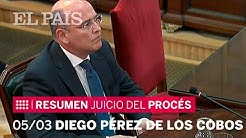
A colonel of the Civil Guard (Guardia Civil)* makes an imposing impression, even if he is in civilian clothes, without a tricorn and with a traveling bag in his hand. This is how Diego Pérez de los Cobos, - the head of the combined police forces deployed in Catalonia during the illegal referendum on October 1 -, appears before the court. The defendants watch him entering the Plenary Hall with a serious gesture, except for Jordi Cuixart, who always laughs full-throated, as if he did not know or did not care that the Prosecutor's Office asked for a 17-year prison sentence.
From his first answers, Pérez de los Cobos's witness statement is similar in two very important aspects to what Enric Millo, - the ex-delegate of the Government in Catalonia -, stated in the morning, and what José Antonio Nieto, - the former Secretary of State for Security-, had declared Monday afternoon: the three statements seem credible and the three of them put into question the pacifist and dialogue-driven discourse of the secessionist leaders on the basis of numerous data, dates and first-hand instances of personal experience. As a result, by the end of the morning and for the first time since the trial began, the defence lawyers start to look visibly nervous. To the point that, in the last moments of Millo's declaration, Judge Manuel Marchena has to cut short the interrogation of one of the defence lawyers:
- Let's see, Mr. Van den Eynde. This is a legal debate. It gives the impression that you are contradicting the witness. Do not use irony in that way.
In addition to Marchena, Judge Luciano Varela, the most senior of the seven members of the tribunal, who founded Judges for Democracy in 1983, is visibly upset with the improper attitude of some of the lawyers. Marchena's admonition - and the lunch hour, sacred in the Supreme Court- throws water into the fire, but Pérez de los Cobos’s accurate, serene declaration in the afternoon abound in the same sensation, without him staggering at any time before the logical traps that the defenders try on him: In the eve of October 1 those who sought a peaceful and dialogued solution before the imminent convocation of the illegal referendum were not precisely Carles Puigdemont and his counsellors.
Such an intention is rebutted by the account of the three witnesses of the Security Board meeting held in Barcelona on September 28 under Puigdemont’s presidency. A meeting that for José Antonio Nieto was "surreal", for Enric Millo "ludicrous" and for Diego Pérez de los Cobos "kafkian". Maybe the person who described it best was Nieto on Monday - "we were sitting at a table to prevent the referendum with those who had organized it for October 1st" -. However, Millo contributed in his statement personal details that caused a lot of damage to the defence strategy simply because, whilst Nieto has a Cordovan accent and Pérez de los Cobos is a civil guard, Millo is called Enric and, - as he emphasized -, he has lived in Catalonia all his life. He represents the part of Catalonia, that yes, which did not live those days in the avenues of independence euphoria, but in the alleys of anguish. The Catalonia of all those who opposed the secessionist drift. When the ex-delegate of the Government said that in Girona, - where he has lived 27 years -, there appeared a graffiti saying "Millo, death", a defence lawyer asked:
- Do you know who did it?
-I do not know who did it, but I know who did clean it up: it was my daughter.
There is a sentence that will not make it to any press headline, but which the ex-delegate of the Government repeated twice or thrice at different stages of his statement. The sentence is: "I left that meeting very worried". He refers to the meetings he had with president Carles Puigdemont, Vice President Oriol Junqueras or Home Affairs counsellor Joaquim Forn in order to find a legal alternative to the referendum and which always ended up crashing into a wall. "Their response was always the same," - Millo explains -, "the referendum was going to be held. They were not interested in anything else than having the referendum”.
It's already dark in the Villa de Paris square. Inside the Plenary Hall, Javier Melero, the defence's most seasoned lawyer, has tried unsuccessfully for three hours to find a hole to get to Pérez de los Cobos, but he cannot. The colonel of the Civil Guard, who has been trained in the fight against ETA but also in the advice of ministers of Home Affairs of both the PSOE and the PP, provides a perfect chronological account to support his thesis: the Mossos d'Esquadra favoured the referendum instead of preventing it. Each time the lawyer asks a question in the form of an arrow, the civil guard returns it with poison at the tip:
- Do you know how many complaints there are against police and civil guards for the charges of October 1?
-I have more than 100 dismissals and no convictions.
-And if you say that you were received in the polling stations with violence, is not it surprising that there were no arrests?
-I do not find it surprising. When in a given situation there comes about much higher violence than initially foreseen, the priority is to implement the mission, not to make arrests.
Melero does not know anymore what to ask. A young woman lawyer says something in his ear. In the end, he gives up.
-No more questions.
Pérez de los Cobos smiles.

* Note of the unofficial translator: The Guardia Civil is a military force charged with, a.o., police and safety duties under the authority of both the Ministry of Home Affairs and the Ministry of Defence.
https://en.wikipedia.org/wiki/Civil_Guard_%28Spain%29


ESPAÑOL

Las defensas empiezan a ponerse nerviosas

https://elpais.com/politica/2019/03/05/actualidad/1551818292_205209.html


Share:

Friday, March 08, 2019

Ex-Leader of Catalan Nationalist Government Coalition (CiU) Josep Duran i Lleida: "Artur Mas (ex- president of Catalonia) rebuffed a deal offered by M. Rajoy (ex-president of Spain) to be voted by Catalans"

EN ES

José Rico
4/3/2019 El periódico


ENGLISH

Ex-leader of "Unió ( Democratic Union of Catalonia, Christian Democrat) reveals a frustrated mediation between both presidents before "N9" (An illegal consultation on independence organized by the Catalan government on November 9th, 2014).

Ex-president of Spain offered exploring a political agreement in case CiU promised to endorse it.

Despite a noisy reaction by the Popular Party and other right wing organizations in view of (president) Pedro Sanchez´s proposal to bring an independent witness ("relator") into the dialogue between the central government and the Generalitat (Catalan government) so as to acknowledge the true nature of conversations, the trial of the "Procés" (pro independence leaders) in the Supreme Court is helping cast light on the multiple attempts at mediation made throughout the Catalan conflict when the tenant of "La Moncloa" (Spain´s presidential palace) bore the name of Mariano Rajoy. Two of the attempts were revealed by "El Periódico of Catalonia"; the first by Iñigo Urkullu - president of the Basque Country who tried to stop "in extremis" both; the DUI (the unilateral declaration of independence by the Catalan government) as well as the declaration of Article 155 of the constitution (authorizing Rajoy´s intervention of the Catalan regional government sanctioned by the Senate) and the second; a mediation which took place between 2013 and 2014 led by three emissaries: Joan Rigol, Pedro Arriola and José Enrique Serrano.

However the latter was not the only secret mission carried out in the previous months to the 9N. Josep Duran Lleida (historical leader of the CiU coalition in Spain´s Congress in Madrid) reveals now a third one.

In an interview published today (March 2nd, 2019) in El Periodico of Catalonia, Duran assures that before N9, Rajoy accepted exploring a political accord which could have later been voted by Catalans as long as the CiU coalition (then in office in Catalonia) committed to endorsing it in Catalonia. However, according to the ex leader of the now extinct "Unió", the person who derailed such an agreement was then president of the "Generalitat" (Catalan government) Artur Mas, who once on top of the pro independence wave alleged he could not ensure such a proposal would be validated by the secessionists at the voting station.

"Before the N9 consultation conversations between Arriola (Spanish government mediator) and Rigol (Catalan government mediator) took place and at a given moment, Rajoy and I spoke about a potential political proposition which would have been subjected to popular vote. With all the common sense, Rajoy asked if such a proposal would be endorsed by us. I replied "of course" and that I would check with Mas (Catalan president). At that moment Mas rejected the poposal, fearing the reaction of the pro independence voters. Rajoy became angry - and I agreed with him - for two reasons: first, because Mas did not wish to endorse anything which could have come out of a negotiated agreement and secondly, because Rajoy found out through the media about the double-question that was going to be submitted to consultation on N9. It was then that Rajoy said 'Enough¡'", reveals Duran during the interview.

This episode is included in 'The Risk of the Truth' (Editorial Planeta), the political memoirs which the veteran Christian Democrat leader published last Tuesday. According to Duran, it was a real attempt to reach a political solution aiming to avoid a train collision, stating; "such failure was far from being of Rajoy's exclusive responsibility," although he criticizes the ex president of the (Spanish) Government for not having later tried again to "reignite dialogue".

Nonetheless this is not the only dart thrown during the interview by Duran against Mas, with whom he never maintained the best of relationships. He blames Mas for having climbed into the bandwagon of the pro independence movement for "lack of political talent" , "getting carried away by mediocre advisors, whose analysis led to the present situation." Duran accuses the same milieu of having "invented" the concept of "right to decide" equating it with the right of self-determination, which, in his opinion, "is reserved for realities that have nothing to do with Catalonia´s"

Regarding the fuze which unleashed the 'procés (pro independence process); the slamming of Rajoy to a tax deal in 2012, Duran holds the view that Mas "went to La Moncloa - presidential palace - with the will to close the door, having done nothing to prevent it from being closed ". However the hardest grudge against 'expresident' Mas is "having delivered Catalonia to the CUP" (ultraleft pro independence coalition); something which "I never, never, never - and I will repeat it over and over again - would have expected from Mas".

On Pujol, Puigdemont, Junqueras …(ex presidents and ex VP of the Catalan government, respectively)

The ex leader "Unió" blames "ERC´s" (center left pro independence party) pressure on Mas's for the latter´s resignation from the presidency of the Generalitat and confesses he was perplexed by Mas´s appointment of Carles Puigdemont, "a person who has always been crazy," as replacement.

In such a settling of accounts, Duran accuses Jordi Pujol - the man who disappointed him by not anointing Duran as successor (for the Catalan presidency), in favor of Mas - to have used his years of government to prepare the Catalans "tacitly" so that they would "carry on assuming the sovereignist creed ", going as far as assuring that "underneath " he has always been pro independence.

Puigdemont (ex Catalan president) and Oriol Junqueras (ex vice-president now under trial) are not free from Duran's scourge either.

Duran accuses the (recent Catalan) expresident of having squandered the "revenue" which could have been obtained from the great mistake committed by the Spanish government on October 1st 2017 (date of the illegal referendum), by having opted for the unilateral route, reminding it was the ERC leader (Junqueras), "who today appears as the kindest person, who actually squeezed Puigdemont so that he would not call elections instead opting for a DUI (UDI, unilateral declation of independence). "

Regarding the present situation, the former Christian Democrat leader applauds (Pedro) Sanchez's (President of Spain) attempt to "deflate the conflict", regretting that he has been played by the separatists at the game of "seven and a half". He reproaches the pro independence leaders who, "by claiming more and more cards," have shown that they simply "don´t want a dialogue."


ESPAÑOL

Duran: "Mas rechazó un pacto con Rajoy que se pudiera votar en Catalunya"


Share:

Thursday, March 07, 2019

Trial of the "procés": the allegations and the facts

EN ES

Teresa Freixes
Professor of Constitutional Law at the Autonomous University of Barcelona

04/03/2019 La razón


ENGLISH
We are so accustomed to American films that many complain that in the "trial of the century" there is no emotion, that the Prosecutor's Office does not corner the accused and that the president of the Tribunal is excessively condescending with many of those who have been appearing before the Court, especially with secessionist politicians. With the commencement of the evidentiary phase, after the defendants had testified, the testimony of the witnesses has given rise to a kind of "change of direction". If the defendants accepted their right not to testify and not to confess guilt, even to issue considerations and political allegations, the witnesses, on the contrary, must declare obligatorily and under oath. That is why witnesses have not been able to hold political rallies or have been sanctioned when they have refused to testify. That is why Junqueras, as defendant, was able to make use of all the staging he wanted to give us while Tardà, as a witness, had to declare following the facts and in the terms set by President of the Court Marchena.

Also as witnesses declared the main politicians of the PP government, the former president, the former vice president, the former finance minister or of the Interior. They were interrogated about a set of actions that were aimed at replacing the constitutional, statutory and legally established order in Catalonia with another, regardless of the procedures legally provided for it. Their answers did not go into detail about what happened during their term and, even, they seemed unaware of facts that we have all seen or read about. Most of the time, they shielded themselves in that they had no operational command. Other politicians also set out positions on general issues, but little did they contribute on the details that will occupy the Tribunal's work from now on.

In this trial the mechanisms by which the independence or the establishment of the republic was sought are going to be criminally assessed: approval and attempt to apply disconnection laws suspended and then declared contrary to the Constitution by the TC; public disorders such as those that occurred in front of the Ministry of Economy, the Courts of Justice or the hotels where the Police were lodged; the alleged illegal "referendum" of the 1-O; de factoproclamation (not de jure) of the independence; or the presumed use of public funds, removing them irregularly despite the control carried out by the Treasury.

Now is when, really, you will enter into the contrasting examination of the facts. Those who were in charge of operatives of all kinds (police charges for example), who suffered the attacks whose violence is discussed (among them the court clerk who had to leave by the roof of an adjoining building in the registry to the Ministry of Economy), or those who intervened in the adoption of parliamentary resolutions, will have to declare. They are going to examine documents, videos, emails, invoices, recordings, one by one ... all kinds of evidence admitted nowadays by our Law of Criminal Procedure.

It is now when the probative value of what the file inquired by Judge Llarena and what can be provided from other courts of Barcelona that are inquiring other aspects of this cause will be appreciated. Based on the contrast between statements and evidence, the Court will be able to assess whether the proven facts are subsumed, or not, in the types of crimes for which the defendants have been prosecuted: rebellion, sedition and embezzlement.


ESPAÑOL

Juicio del "procés": Los alegatos y los hechos

Share:

Wednesday, March 06, 2019

Catalan own-goal on sight!

EN ES DK

Marlene Wind
Professor of the University of Copenahagen
Lørdag 23/02/2019 Berlingske

ENGLISH
The scattered crusades of the Catalan separatists in many ways remind the of the equally extreme Brexiteers in that they not only call their opponents "traitors" and, what is worse, they also reject all the "offers" with which their Prime Minister. tried to return them to the fold.

When I visited Barcelona in November to get interviews for a book on nationalist trends in Europe, two former primary school teachers approached me. They said that they had been dismissed from their jobs as teachers because they had insisted on teaching their students in Spanish instead of Catalan.

Although it surprised me a little, the story coincided with similar stories of professors from Catalan universities who for years had been harassed for refraining from using their Spanish mother tongue.

No matter how much sympathy the Catalan separatists awaken, especially outside Spain, these examples show that fanaticism has replaced common sense for a long time. Despite the broad autonomy the Catalans enjoy and self-government eg. Culture, media and education, etc., full independence is apparently the only thing

On October 1, 2017, the illegal referendum gathered only 43 percent of Catalans to vote for secession. And while the polls repeatedly show that most prefer to stay in Spain, the separatists do not give them credit.

In fact, emotions are high and families and friends have been divided for almost decades l and continue to be so before the 12 Catalan politicians who are currently accused of having forced the referendum on independence in 2017 and misused public funds.

The scattered crusades of the Catalan separatists in many ways remind the of the equally extreme Brexiteers in that they not only call their opponents "traitors" and, what is worse, they also reject all the "offers" with which their Prime Minister. tried to return them to the fold.

There is no doubt that the separatists have chosen conflict as a deliberate strategy to keep their project going. The more confrontation there is , the easier it is to portray themselves as a persecuted innocents and, no less important, maintain power in the regional Catalonian parliament. It also explains why compromise and reconciliation with Madrid has no chance for them. . The confrontation must keep boiling over if the separatist leaders hope to stay in power.

In the recent elections in Catalonia in December 2017, the separatists obtained a slight majority and regained power only because the electoral system favors rural areas. The largest and most popular party became the relatively new liberal (anti-separation) party, Citizens.


The fact that separatists foster conflict was clear when they left Sánchez's fragile socialist government.

Sánchez, who, unlike his predecessor Rajoy, entered into dialogue with the separatists and offered them a budget increase of 18.5%, and was totally ignored. The separatists, at their own discretion, have increased the risk that a much rougher and less dialogue-oriented conservative government will come to power after the April elections, which have already been called.

However, the separatists do not regret it. Both the illegal referendum in 2017 and the escape of the former Catalan leader Puigdemont to Belgium and the media circus that followed were a deliberate attempt to internationalize the conflict. By escalating it simultaneously, they hope to create European pressure on the Spanish government. The attempt to internationalize the conflict has had some success, although nothing indicates that the EU has yet fallen into the trap.

Unworthy strategy

Most people agree that Rajoy behaved like an elephant in a porcelain shop when with his management of the Spanish police of the otherwise quite amateur Catalan referendum in 2017, where several voters voted several times and there was no control about voting at the centers or with the ballots. And most likely, it will also be difficult to understand the severity of the charges for the offense carrying up to 25 years.

However, the strategy of the (Catalan) separatist extortion is not worthy of a modern European democracy. As the Spanish Attorney General recently told the British weekly The Economist, it is not about punishing opinions. Wishing independence is not a problem However, what is not licit is to break with the constitution and divide a country with great consequences for future generations and for the pro-Spanish union Catalan majority.


ESPAÑOL
Cuando visité Barcelona en noviembre para obtener entrevistas para un libro sobre las tendencias nacionalistas en Europa, dos ex maestros de primaria se me acercaron. Dijeron que habían sido despedidos de sus trabajos como maestros porque habían insistido en enseñar a sus estudiantes en español en lugar de catalán.

Aunque me sorprendió un poco, la historia coincidió con historias similares de profesores de universidades catalanas que durante años habían sido hostigados para abstenerse de usar su lengua materna española.

No importa cuánta simpatía despiertan los separatistas catalanes, especialmente fuera de España, estos ejemplos muestran que el fanatismo ha reemplazado el sentido común desde hace mucho tiempo. A pesar de la amplia autonomía que gozan los catalanes y el autogobierno, por ejemplo. Cultura, medios de comunicación y educación, etc., la independencia total es aparentemente lo único válido.

El 1 de octubre de 2017, el referéndum ilegal reunió en las urnas solo al 43 por ciento de los catalanes. Y mientras las encuestas muestran repetidamente que la mayoría prefiere quedarse en España, los separatistas no les dan crédito.

De hecho, las emociones son altas y las familias y los amigos han estado divididos durante casi décadas y continúan estándolo ante los 12 políticos catalanes que actualmente están acusados de haber forzado el referéndum sobre la independencia en 2017 y de abusar de los fondos públicos.

Las cruzadas dispersas de los separatistas catalanes de muchas maneras recuerdan a los Brexiteers igualmente extremos en que no solo llaman "traidores" a sus oponentes y, lo que es peor, también rechazan todas las "ofertas" con las que su Primer Ministro. Intenta devolverles al redil.

No hay duda de que los separatistas han elegido el conflicto como una estrategia deliberada para mantener su proyecto en marcha. Cuanta más confrontación haya, más fácil será presentarse como inocentes perseguidos y, no menos importante, mantener el poder en el parlamento regional catalán. También explica por qué el compromiso y la reconciliación con Madrid no tienen oportunidad para ellos. .La confrontación debe mantenerse en ebullición si los líderes separatistas quieren seguir en el poder.

En las recientes elecciones en Cataluña en diciembre de 2017, los separatistas obtuvieron una leve mayoría y recuperaron el poder solo porque el sistema electoral favorece a las áreas rurales. El partido más grande y popular se convirtió en el relativamente nuevo partido liberal (anti-separación), Citizens.


El hecho de que los separatistas persiguen el conflicto fue claro cuando abandonaron el frágil gobierno socialista de Sánchez.

Sánchez, quien, a diferencia de su predecesor Rajoy, entró en diálogo con los separatistas y les ofreció un aumento de presupuesto del 18.5%,, fue totalmente ignorado. Los separatistas, a su propia discreción, han aumentado el riesgo de que un gobierno conservador mucho más áspero y menos orientado al diálogo llegue al poder después de las elecciones de abril, que ya han sido convocadas.

Sin embargo, los separatistas no se arrepienten. Tanto el referéndum ilegal en 2017 como la huida del ex líder catalán Puigdemont a Bélgica y el circo mediático que siguió fueron un intento deliberado de internacionalizar el conflicto. Al escalarlo simultáneamente, esperan crear presión europea sobre el gobierno español. El intento de internacionalizar el conflicto ha tenido cierto éxito, aunque nada indica que la UE haya caído en la trampa.

Estrategia indigna

La mayoría de las personas están de acuerdo en que Rajoy se comportó como un elefante en una caharrería en su gestión de la policía española durante el referéndum catalán en 2017, por otra parte bastante amateur, donde varios votantes votaron varias veces y no hubo control sobre la votación en los centros o con las papeletas. Y muy probablemente, también les resulte difícil comprender la gravedad de los cargos para el delito de hasta 25 años.

Sin embargo, la estrategia de la extorsión separatista (catalana) no es digna de una democracia europea moderna. Como dijo recientemente el fiscal general español al semanario británico The Economist, no se trata de castigar las opiniones. Desear la independencia no es un problema. Sin embargo, lo que no es lícito es romper con la constitución y dividir un país con grandes consecuencias para las generaciones futuras y para la mayoría catalana pro-española.

DANSK

Catalansk selvmål i sigte

https://www.berlingske.dk/kommentatorer/catalansk-selvmaal-i-sigte

Share:

Tuesday, March 05, 2019

Procès des indépendantistes catalans: non, l’Espagne n’est pas une dictature!

FR

Alfonso Valero
05/03/2019 LE SOIR


FRANCAIS
Les séparatistes catalans ne sont pas jugés pour avoir voté lors du référendum sur l’indépendance, mais pour avoir enfreint la légalité constitutionnelle et essayé de la supplanter par une législation alternative et illégitime, estime l’auteur de cette carte blanche.


Comme les lecteurs de ce journal le savent, depuis le 12 février se déroule le procès de douze des leaders séparatistes catalans. Il ne s´agit pas d´un procès de tous les leaders séparatistes, ni d´un procès de tous les accusés puisqu´il y en a sept en fuite. Il est nécessaire d’insister sur ce point car en Espagne il y a beaucoup de personnes (élues ou pas) qui défendent la sécession d´une part du territoire national et qui ne sont ni poursuivies en justice ni menées devant les tribunaux puisqu’en Espagne, personne n´est jugé à cause de ses opinions politiques. Il est également important de rappeler que Carles Puigdemont, Antoni Comin, Meritxell Serret, Anna Gabriel, Marta Rovira et Clara Ponsatí, auteurs des mêmes faits jugés maintenant par la Cour Suprême espagnole, ont fui l´Espagne, ce qui prouve qu’il existait bien un risque de fuite des autres poursuivis. Carles Puigdemont, par exemple, demeure à Waterloo d´où il dirige toute sa propagande sécessionniste.


Un cliché démenti par les chiffres


Cet article n´a pas pour but de convaincre les lecteurs sur le bien-fondé de l’une ou l´autre position. Il essaie tout simplement d´expliquer la procédure pénale devant la Cour Suprême, afin que chacun puisse se faire sa propre opinion.

LIRE AUSSI

Carte blanche: «Catalogne, un procès contre la démocratie»

Mesdames et Messieurs, Franco est bien mort. L´une des accusations les plus fréquentes contre la jeune démocratie espagnole est que l’héritage de Franco reste vivant. Cette affirmation est un cliché du passé qui est démenti par la pleine intégration de l´Espagne dans tous les organismes internationaux qui exigent une démocratie pleine, tels que l’Union européenne (depuis 1986) et le Conseil de l´Europe, ainsi que la Cour européenne des Droits de l’Homme. D’après le Rapport Annuel 2018 de la Cour européenne des Droits de l´Homme, l´Espagne est l´un des pays les moins convoqués devant sa Cour (0,13 requête pour 10.000 habitants, face à 0,16 pour la Belgique et 0,52 en moyenne) et ayant le moins de condamnations (167 arrêts depuis 1959, face aux 252 arrêts pour la Belgique pendant la même période). De plus, d´après l´Economist Intelligence Unit appartenant au journal The Economist, l´Espagne est depuis quelques années l´une des vingt démocraties pleines du monde.

LIRE AUSSI

La justice espagnole sur le banc des accusés au procès des indépendantistes

La démocratie espagnole garantit même le droit d´activisme contre son intégrité territoriale. Grâce à ça, M. Torra, Président de la Région Autonome de Catalogne, put assister à ce procès devant la Cour Suprême et soutenir ensuite des positions séparatistes, comme il le fait depuis des années. En réalité, les vestiges du fascisme se retrouvent plutôt dans le nationalisme catalan. Rappelez-vous simplement que M. Torra est un leader politique suprémaciste et xénophobe qui a rendu hommage à plusieurs reprises aux frères Badia, créateurs des années trente du XXe siècle d´un mouvement inspiré du fascisme italien.


Rébellion et violence

Une autre erreur fréquente consiste à dire qu´en Catalogne il n’y a pas eu de rébellion parce qu´il n´y a pas eu d’actes de violence, puisque voter est un acte pacifique. À vrai dire, on ne juge pas ces douze séparatistes pour avoir voté, puisqu’en effet cela ne représente pas un acte violent. On les juge pour avoir enfreint la légalité constitutionnelle et essayé de la supplanter par une législation alternative et illégitime ; pour avoir entravé, à l´aide de la force physique, l´enquête judiciaire sur le financement du référendum illégal ; pour avoir employé la police régionale pour empêcher l´action de la police nationale qui, en suivant les instructions du juge compétent, essayait d´empêcher le référendum illégal, ainsi que pour avoir réalisé ledit référendum en pleine connaissance des conséquences violentes qui pourraient s´en suivre, comme ce fut le cas. En effet, beaucoup de preuves montrent des nationalistes désireux de déclencher un processus de violence dans l´espoir d´internationaliser la situation.

LIRE AUSSI

Espagne: un procès exceptionnel très politiqueDes subventions sujettes à caution

Enfin, certains disent qu’Omnium Cultural, Assemblea Nacional Catalana et d´autres groupes nationalistes sont des mouvements civiques à but non lucratif. Si nous considérons le motif du profit comme une entité faisant partie du marché libre, nous acceptons que ces organisations n´ont pas de but lucratif. Mais il faut rappeler que ce sont des organisations puissamment subventionnées par l´argent du contribuable, qui, comme le révèle l´enquête judiciaire, n´a pas été destiné à des fins publiques. Par exemple, l’organisation Omnium Cultural a reçu environ dix millions d’euros dans les dix dernières années. On se concentre sur Omnium parce qu´elle fut créée pendant l’époque de Franco, en 1961. Elle fut déclarée illégale entre 1963 et 1967, mais depuis elle a repris ses activités jusqu´à nos jours. Bien entendu Omnium Cultural n´est pas un « héritage franquiste », mais au long de ces vingt dernières années, elle a quitté son rôle de promotion de la culture catalane pour devenir une organisation qui milite pour le séparatisme.


Une procédure transparente

En conclusion, toute procédure judiciaire doit pouvoir faire l´objet d´un suivi et d´une évaluation, y compris celle concernant les douze séparatistes catalans. Toutes les séances de la Cour Suprême sont publiques dans le sens le plus vaste possible, puisqu´elles peuvent être suivies en direct par internet en streaming, ce qui est sans précédent dans n´importe quelle démocratie du monde. Cependant, les sentiments que cette procédure peut éventuellement éveiller ne devraient pas être extrapolés de façon paresseuse et ignorante à la démocratie espagnole, qui fait preuve de fermeté justement en se défendant de ses ennemis sur la base d´un procès équitable et avec toutes les garanties procédurales d´un État de droit.

Comme les lecteurs de ce journal le savent, depuis le 12 février se déroule le procès de douze des leaders séparatistes catalans. Il ne s´agit pas d´un procès de tous les leaders séparatistes, ni d´un procès de tous les accusés puisqu´il y en a sept en fuite. Il est nécessaire d’insister sur ce point car en Espagne il y a beaucoup de personnes (élues ou pas) qui défendent la sécession d´une part du territoire national et qui ne sont ni poursuivies en justice ni menées devant les tribunaux puisqu’en Espagne, personne n´est jugé à cause de ses opinions politiques. Il est également important de rappeler que Carles Puigdemont, Antoni Comin, Meritxell Serret, Anna Gabriel, Marta Rovira et Clara Ponsatí, auteurs des mêmes faits jugés maintenant par la Cour Suprême espagnole, ont fui l´Espagne, ce qui prouve qu’il existait bien un risque de fuite des autres poursuivis. Carles Puigdemont, par exemple, demeure à Waterloo d´où il dirige toute sa propagande sécessionniste.


Un cliché démenti par les chiffres


Cet article n´a pas pour but de convaincre les lecteurs sur le bien-fondé de l’une ou l´autre position. Il essaie tout simplement d´expliquer la procédure pénale devant la Cour Suprême, afin que chacun puisse se faire sa propre opinion.

LIRE AUSSI

Carte blanche: «Catalogne, un procès contre la démocratie»

Mesdames et Messieurs, Franco est bien mort. L´une des accusations les plus fréquentes contre la jeune démocratie espagnole est que l’héritage de Franco reste vivant. Cette affirmation est un cliché du passé qui est démenti par la pleine intégration de l´Espagne dans tous les organismes internationaux qui exigent une démocratie pleine, tels que l’Union européenne (depuis 1986) et le Conseil de l´Europe, ainsi que la Cour européenne des Droits de l’Homme. D’après le Rapport Annuel 2018 de la Cour européenne des Droits de l´Homme, l´Espagne est l´un des pays les moins convoqués devant sa Cour (0,13 requête pour 10.000 habitants, face à 0,16 pour la Belgique et 0,52 en moyenne) et ayant le moins de condamnations (167 arrêts depuis 1959, face aux 252 arrêts pour la Belgique pendant la même période). De plus, d´après l´Economist Intelligence Unit appartenant au journal The Economist, l´Espagne est depuis quelques années l´une des vingt démocraties pleines du monde.

LIRE AUSSI

La justice espagnole sur le banc des accusés au procès des indépendantistes

La démocratie espagnole garantit même le droit d´activisme contre son intégrité territoriale. Grâce à ça, M. Torra, Président de la Région Autonome de Catalogne, put assister à ce procès devant la Cour Suprême et soutenir ensuite des positions séparatistes, comme il le fait depuis des années. En réalité, les vestiges du fascisme se retrouvent plutôt dans le nationalisme catalan. Rappelez-vous simplement que M. Torra est un leader politique suprémaciste et xénophobe qui a rendu hommage à plusieurs reprises aux frères Badia, créateurs des années trente du XXe siècle d´un mouvement inspiré du fascisme italien.


Rébellion et violence


Une autre erreur fréquente consiste à dire qu´en Catalogne il n’y a pas eu de rébellion parce qu´il n´y a pas eu d’actes de violence, puisque voter est un acte pacifique. À vrai dire, on ne juge pas ces douze séparatistes pour avoir voté, puisqu’en effet cela ne représente pas un acte violent. On les juge pour avoir enfreint la légalité constitutionnelle et essayé de la supplanter par une législation alternative et illégitime ; pour avoir entravé, à l´aide de la force physique, l´enquête judiciaire sur le financement du référendum illégal ; pour avoir employé la police régionale pour empêcher l´action de la police nationale qui, en suivant les instructions du juge compétent, essayait d´empêcher le référendum illégal, ainsi que pour avoir réalisé ledit référendum en pleine connaissance des conséquences violentes qui pourraient s´en suivre, comme ce fut le cas. En effet, beaucoup de preuves montrent des nationalistes désireux de déclencher un processus de violence dans l´espoir d´internationaliser la situation.

LIRE AUSSI

Espagne: un procès exceptionnel très politiqueDes subventions sujettes à caution

Enfin, certains disent qu’Omnium Cultural, Assemblea Nacional Catalana et d´autres groupes nationalistes sont des mouvements civiques à but non lucratif. Si nous considérons le motif du profit comme une entité faisant partie du marché libre, nous acceptons que ces organisations n´ont pas de but lucratif. Mais il faut rappeler que ce sont des organisations puissamment subventionnées par l´argent du contribuable, qui, comme le révèle l´enquête judiciaire, n´a pas été destiné à des fins publiques. Par exemple, l’organisation Omnium Cultural a reçu environ dix millions d’euros dans les dix dernières années. On se concentre sur Omnium parce qu´elle fut créée pendant l’époque de Franco, en 1961. Elle fut déclarée illégale entre 1963 et 1967, mais depuis elle a repris ses activités jusqu´à nos jours. Bien entendu Omnium Cultural n´est pas un « héritage franquiste », mais au long de ces vingt dernières années, elle a quitté son rôle de promotion de la culture catalane pour devenir une organisation qui milite pour le séparatisme.


Une procédure transparente


En conclusion, toute procédure judiciaire doit pouvoir faire l´objet d´un suivi et d´une évaluation, y compris celle concernant les douze séparatistes catalans. Toutes les séances de la Cour Suprême sont publiques dans le sens le plus vaste possible, puisqu´elles peuvent être suivies en direct par internet en streaming, ce qui est sans précédent dans n´importe quelle démocratie du monde. Cependant, les sentiments que cette procédure peut éventuellement éveiller ne devraient pas être extrapolés de façon paresseuse et ignorante à la démocratie espagnole, qui fait preuve de fermeté justement en se défendant de ses ennemis sur la base d´un procès équitable et avec toutes les garanties procédurales d´un État de droit.

https://plus.lesoir.be/210191/article/2019-03-05/proces-des-independantistes-catalans-non-lespagne-nest-pas-une-dictature
Share:

Three weeks of trial, three critical reports of alleged foreign 'observers'

EN ES
Pablo Gabilondo
05/03/2019 El Confidencial

ENGLISH
The platform is called International Trial Watch, but behind it there are six Catalan associations that issue a weekly report in which they denounce aspects of the procedure

The Supreme Court rejected at the beginning of February to reserve seats in the room for foreign jurists in the trial of 'procés'. Despite this, six Catalan associations have gone ahead with the idea and since the first day have introduced international and national 'observers' in the room, an objective that they have pursued with the launch of a new organization that they have baptized with an Anglo-Saxon name: International Trial Watch. Its promoters have already published three weekly reports in which they criticize different aspects of the procedure in both French and English, which is why El Confidencial wanted to interview one of its promoters, lawyer Xavier Muñoz:

QUESTION. If the trial is broadcasted live entirely and access to the room is free, why do you need observers?

ANSWER. The figure of the international observer is a figure to be used in trials of legal transcendence. This happened for example in the trial against Pablo Ibar in Florida, when he faced the death penalty. The Parliament or the Basque Government then sent a delegation of observers, of jurists, so that they could observe and draw their own conclusions. From my own experience, it is one thing to follow the procedure via television and quite another to be inside and perceive sensations, gestures...

Q. Being six Catalan associations, why did they choose a name in English for their organization?

A. Because our goal is to bring people of reference, human rights defenders and jurists of a certain international level, as many as we could, then the communication channel should be in English.
The foreign jurists invited by the association gathered headlines from the first day. Although the Supreme Court had refused to keep a spot for the 'observers', when the moment of truth arrived, several lawyers linked to International Trial Watch found a way to access the room: they were identified in the police control as lawyers and they were given an accreditation of this type, which gave them preference over the general public and the possibility of skipping the corresponding queue to enter, explain judicial sources. The surprise came when they wanted to enter the high court and staff of the Supreme Court warned that several men dressed in lawyers’ robes wanted to occupy seats for the general public, a situation not resolved until the lawyers took off such clothings.
"I'm not at all in agreement with that information", Muñoz defends when asked about it. "I know there was a bit of trouble, but I do not know that anyone from our platform came under those circumstances". One of our observers, a Belgian gentleman in such a robe, came in and they took it away, but I do not know that anyone came inside wearing those clothes", he says.

Regarding how they select these international jurists, Muñoz points out that "through their international ‘background'” they connect with "persons of reference" who are willing to attend the trial."There are organizations that are dedicated to human rights issues at the international level, in my case I am dedicated to the legal profession and I have contacts as member of the European Democratic Lawyers Association. It is through these contacts and the references gathered that we study the profiles", he says. When the selected jurist accepts, International Trial Watch is then responsible for paying for his travel and accommodation, expenses that, they claim, cover through "donations". Asked how much they have spent in these first three weeks, Muñoz says that they prefer not to give the information at the moment: "At the end of everything a report will be made".


Criticism of the trial


The platform is made up of six Catalan associations: Associació Catalana per la Defensa dels Drets Humans, Collectiu Praga, Institut de Drets Humans de Catalunya, Irídia, Novact and the Observatori del Sistema Penal y els Drets Humans of the Autonomous University of Barcelona. In their weekly reports, however, these organizations do not appear, but the International Trial Watch logo on the phrase 'Catalan Referendum Case'.

The releases also start with the 'observers' who have attended the trial that week. "In every session we have had until now, at least one observer has entered each of the sessions, while the representatives of International Watch only function as accompaniment, inform them about the context, act as spokesperson if necessary ... But I cannot say with a 100% of accuracy if the person who has entered in each session was of Spanish or foreign origin", he explains.

Once the jurists who support the weekly report are presented, the texts then provide a series of assessments regarding the performance of the court. The first week, the platform criticized that "the accusations do not take into account that the actions of the defendants may be covered by fundamental rights" and that "they introduce new facts in their questions". The second, they denounced the "inaccuracies" and "tricky questions" of the Prosecutor, "the alteration of the order in the practice of the evidence", the "especially worrying" issues about freedom of assembly ... And the third, they applauded the "enabling of one more day for the sessions" while charging against the "treatment of freedom of expression and the right of assembly and demonstration in interrogations" or that there is no "calendar of trial sessions".

For the time being, the formula for the weekly reports has managed to capture the attention of the media. "We send our notes and calls to media throughout the Spanish State; another thing is the media paying attention to us. Which one takes our case or not, this does not depend on us. We give our opinions to whoever might be interested; if not, then there is no problem", explains Muñoz. "Evidently, the case is being followed more often in Catalonia, then the Catalan media not only pay more attention to our platform but also to the trial".

In this way, headlines such as "International observers criticize the Prosecutors’ 'criminalization' of the right to demonstrate" or "International observers warn of the 'political burden' of the trial of 1-O" have managed to find a niche in the Catalan press.


SPANISH

Tres semanas de juicio, tres informes críticos de los supuestos 'observadores' extranjeros

Share:

Either it's water or it's dry

EN ES
Joan Coscubiela
21/02/2019 El diario.es EFE

ENGLISH
The double talk has been the most constant component in the pro-independence strategy, saying one thing and the opposite, playing cunning to maintain its fiction

Sorry for the truism of the title, but I found it more pertinent to start with a truism than with an oxymoron like "dry water". Although both formulas serve to explain what I consider the most important, in the political sphere, of everything that has been said during the first days of a trial that, at times, is so difficult to distinguish from the election campaign.

After listening to the allegations of the accused persons and their lawyers in favor of the right to self-determination, Joaquin Forn's statement - by the way very well articulated - offered us a moment of great political significance. The person who was minister of home affairs has affirmed that the Unilateral Declaration of Independence (DUI) was only read, not voted. A line of defense followed later by Raül Romeva, Jordi Turull and others when they referred to that action as a simple political statement with a vocation for negotiation.

We are witnessing a strategy that in the juridical level can be considered intelligent but that in the political level confirms that the independence movement continues to play on cunning and fiction and remains trapped between two drives: survival or suicide. Everything points to the fact that during the long sessions of the trial we will see more statements reiterating that skilful reading of the facts. To the point of making us doubt whether the DUI existed and was only a mirage that we all saw, especially the pro-independence, but never existed.

It should not surprise us, because the double talk has been the most constant component in the pro-independence strategy, saying one thing and the opposite, playing cunning to maintain its fiction. Saying one thing to its followers to demonstrate the strength and solvency of the procés and at the same time the opposite to feign legality.

The examples of "dry water" of the pro-independence movement appear everywhere. First the parish was made to believe that the elections of September 2015 had been the referendum that legitimized the DUI in 18 months, and then, upon the expiration of this period, to affirm the opposite as an argument to propose the referendum as the only option. Remember: "referendum or referendum".

In the same days when Santiago Vidal raised the morale of the troops, assuring that they already had the fiscal data of the entire population, obtained illegally, to build their own treasury, other pro-independence leaders affirmed that everything would be done within the strictest legality. That, remember, happened every day. Even some prestigious jurist dared to explain that the procés strategy was to pass from one law, the Spanish, to another, the Catalan one. As if legality was a free buffet in which each one chooses the laws that he likes and fulfills, while discarding those that he decides to disobey. All this in the name of a supposed superiority of democracy over the law, the great argument, deeply undemocratic, still used these days by President Quim Torra.

The zenith of the astute strategy of "dry water" was lived on October 27, 2017. At the very same time -in a literal sense- in which in the towns and cities thousands of people celebrated the effective arrival of independence -because the independent leaders and related media assured thus - and in the Parliament hundreds of mayors waving about their batons sanctioned the proclamation of the Catalan republic, the pro-independence representatives in the Board of Parliament recorded in the minutes of the last meeting that the resolution that they were going to vote did not have any legal effect.

You can understand that argument before the Board of the Parliament and now before the Supreme Court as a legitimate defense in the face of possible and future legal consequences of their actions. What is incomprehensible in terms of political honesty is that, 16 months after recording that lack of legal force, the resolution continues to be used to legitimize the independence strategy. And to insist on the democratic mandate of October 1 and the threat to reactivate the unilateral declaration of independence of 27-O. Either it is water, or it is dry.

This great ability of the pro-independence procés to sell dry water would not have been possible without the inestimable collaboration of the media. The "Ithaca Media Division" has been a determining factor in consolidating the stories that the independence movement wanted to impose at each moment. Even to resolve their internal struggles, punishing those who dared to distance themselves from the straight path that at every moment marked the procás direction.

During these days we are paying attention to the efforts of the media in the Corporació Catalana de Mitjans Audiovisuals (CCMA) to sell us that on October 27 there was only one public reading of the resolution and no voting that had legal effects. Nothing to object, if it were not for the fact that during so many months they have sold us shamelessly otherwise and have been instrumental in the creation and survival of this fiction. And they have been as well a key factor in achieving that the sudden changes of position and the contradictions of the independence movement could appear to the eyes of its supporters as a great political skill. The same communication technique that has allowed them to see a general strike where there were neither workers nor stoppage in the production of goods and services, only a lockout of the public administration convened by the Government.

All this with the inestimable help of the "Brunete Media Division", which has had an identical behavior to the Ithaca division although its objectives were the opposite. Magnifying the behaviors of the procés supporters to denounce them and demand a firm hand against them, they have also contributed much to consolidating the dry water story. Although all this may seem things of the past, I think on the contrary that we are facing one of the keys to the future; the other will be the sentence issued by the Supreme Court.

That the pro-independence movement abandons this strategy of "dry water" is a determining factor in finding a way out through dialogue. Unless the case might be that, after the trial, some are tempted to "reactivate" the democratic mandate of October 1 or the implementation of the resolution of 27-O. Or they pose again, as in 2015, that the next autonomous elections will be a new plebiscite with referendum strength.

Hopefully the allegations of the accused about the lack of an effective Unilateral Declaration of Independence will convince the Court and serve to avoid the exaggerated and, in my opinion, unjustifiable punishments requested for them. In addition to the human impact that the prison means, with the independence leaders in prison there is no solution, not even a way out of this immense quagmire.

And hopefully the pro-independence movement will abandon once and for all the cunning and fiction in which they continue to be installed. Of course, it is not a question of giving up anything, simply saying to the public whether it is water or dry. The two things at once are impossible, you cannot deceive everyone for so long without it having serious consequences for everyone.

SPANISH

O es agua o es seca

Share:

Monday, March 04, 2019

The Law

EN ES

Juan José Pérez Burniol
La vanguardia
02/03/2019

ENGLISH
These days, it is often claimed as an undisputable principle that democracy is above the rule of law. This daring statement, which is normally declared with as much confident assurance as condescending sufficiency, rests on an initial fallacy: the rule of law would only involve the syllogistic application of the legal rules to concrete facts. Whereas, the truth is that the rule of law is the fundamental ethical and political mandatory principle that free women and men must be governed by predetermined rules which are accepted by all, for the sake of peace and freedom.

Cicero had it clear when he argued that where there is no law, there is no city, that is, no community of citizens who govern themselves. Centuries later, Saavedra Fajardo wrote: "On the stone of the laws, not on the will, true politics is founded. They are the government lines and the highroads of the reason of State. The ship of the republic sails safely taking them as certain courses". And Friedrich Hayek has argued the same not so long ago: what distinguishes a free country from a dictatorship is precisely respect for the rule of law. All this is so because being free means not being subject to the arbitrary will of another person, be it a tyrant or a more or less numerous or enthusiastic crowd. For everyone, rules and governed must submit to the law. There is a special meaning to this when the Constitution itself is concerned, because the constitutional text is the reference which has to be invoked by those who make the laws (the parliaments), by those who apply them (governments and administrations) and those who interpret them (the courts).

Therefore, to oppose the democratic principle to the principle of legality denotes a wrong understanding of what democracy is. This follows from the judgement of the Supreme Court of Canada on the secession of Quebec. Of course, the secessionists claimed the primacy of the people's will based on the democratic principle, which enshrines the people's sovereignty expressed through the ballot. And it is true that, in a representative democracy, the axis of the democratic process rests on the citizens' will expressed through the election of their representatives in the federal Parliament and in the legislative assemblies of the federated States. However, if we identify democracy with the popular will expressed through the vote, such will should not be interpreted out of its context, unconnected to the other principles composing the constitutional order. Thus, in a complex State with different levels of government, there may be different majorities in the federal Parliament and in the assemblies of the federated States, without it being possible to maintain that one majority is more legitimate than another as an expression of the citizens' democratic will. For this same reason, the ruling declares that there is no democracy without rule of law. Therefore, the law establishes the framework within which the "sovereign will" can be expressed and in which its mandate must subsequently be executed.
In sum, for democratic institutions to be recognized as such, it is necessary that they be based on the law: a law that makes citizens' participation and accountability possible, through public institutions established by the Constitution. As the ruling states: "It would be a grave mistake to equate legitimacy with the "sovereign will" or majority rule alone, to the exclusion of other constitutional values". Consequently, in order to assume the scope and relevance of these values, we mast take into account the reasons why neither the Constitution nor the rule of law can be subject to the rule of the majority: 1) To protect fundamental rights and individual freedoms; 2) To protect minorities against the pressures of the majority and guarantee social and political pluralism; 3) To preserve the division of political power at different levels of government, for which it is essential that no elected majority at any of these levels can unilaterally usurp powers that do not correspond to it. Given these three reasons, the conclusion is clear: the majority vote in a federated state or autonomous community does not justify the violation of the Constitution. On that basis, the ruling states that it is a mistake to oppose democracy to the rule of law and constitutionalism, that is, to oppose the democratic principle to the principle of legality: "Viewed correctly, constitutionalism and the rule of law are not in conflict with democracy; rather, they are essential to it". What does not rule out that a political solution must be sought should there be a political problem, but this has to take place always within the framework of law.
References
https://scc-csc.lexum.com/scc-csc/scc-csc/en/item/1643/index.do?site_preference=normal


ESPAÑOL

LA LEY

https://www.lavanguardia.com/opinion/20190302/46771070074/la-ley.html
Share:

Highlighted

Trials of Catalan activists - the what the why and how great academic centers are unwittingly contributing to undermining a European democracy

Twelve former Catalan politicians and activists are currently facing trial before the Spanish Supreme Court for charges ranging from m...

Blog Archive