Showing posts with label Catalan insights. Show all posts

Sunday, March 24, 2019

Republic without fraternity


Republic without fraternity

Many of us could not and cannot get on an artifact that divides rather than unite civilly, which makes impossible the debate on reforms undoubtedly necessary both in Catalonia and Spain


Josep Maria Fradera

20 MAR 2019 - 00:00 CET


The most intriguing concept of the French revolutionary triad is undoubtedly that of fraternité. Concept used profusely during the Great Revolution, its consolidation as part of the revolutionary emblem was not achieved until the revolution of 1848 that liquidated the monarchy of Louis Philippe of Orleans. It was in that brief experience when the canonical currency of freedom, equality and fraternity was definitively established. Certainly, the consecration of the first two concepts never caused great ideological complications among the republican factions. In the criticism of the nobility monarchy and the Church, freedom and equality were ideological pieces whose legitimating function offered few doubts. Fraternity was something else, starting with its very presence in the culture of sensibility at the end of the Enlightenment. With the affirmation of workers and socialist societies in nineteenth-century France, the concept of equality reached for obvious reasons a dimension only hinted at during the events that took place between the taking of the Bastille in July 1789 and the 18th Brumaire of the year VIII (November 1799).

The triple motto covered old achievements and established new promises of greater social and cultural depth

If the very notion of fraternity was incarnated in such an erratic way in the French revolutionary dynamic, it is due, as we indicated, to its origin and diffuse meaning. As Marcel David explained in a book devoted entirely to the word and concept, the revolutionaries of 1789 tried to give a life according to the times to the old idea of natural law and Christian iusnaturalist law and its logical corollary, which referred to the idea of common benefit. It is understandable that some of the revolutionaries most sensitive to the problems of a broad consolidation of the revolution, such as Jacques Pierre Brissot, leader of one of the Girondist factions who ended up in the guillotine, a politician with a close relationship with the abolitionist Quakers of Pennsylvania, were very receptive to a concept of that style. Anyway, the radicalization of the revolutionary process put aside those differences for more than half a century. Revolutionary war and the elimination of the adversary, a dynamic reminiscent of similar experiences in the 20th century, closed that stage until the change of regime in February 1848 placed the idea of the emancipation of slaves on the table again, the working population and women. In short, of those who had been excluded from voting and political representation in earlier stages. The triple motto of the revolution embraced old achievements and established new promises of greater social and cultural depth. In that context, the fraternity was called to endure in close association with the French republican idea, to powerfully influence experiences inspired by it, including contemporary Spain.

It is to be powerfully noticed the absence of the idea of fraternity within the common ideological and cultural substrate of the imagined republic to which an important part of Catalan politics aspires, as well as its passionate and numerous followers. Being like a late formulation of a century-old political tradition, a tradition that had succeeded in merging elements of the old and new Catholic tradition, a discreet mesocratic ethnocentrism, a dose of republicanism prior to the Civil War and a justified claim of language and culture after 40 years of intolerable crushing, the recent nationalist radicalism has modified the elements of that synthesis. In effect, the idea of a republic offered not long ago to legitimize a different cocktail, neither of the right nor of the left, neither trade union nor employer, nor xenophobic nor solidary, but quite the opposite, with the result of a complete disorientation of supporters and adversaries. In short: substantially altering the culture that underlies any political movement. As this alchemy is not included in the political programs that the parties exhibit, the definition of instrumental independence, as it was also the case before the word separatism, makes it even more difficult to describe what was happening. Added to this confusion is the impossibility of defining the ideological nature of populist movements in the past and now in vogue, for which the usual definitions do not work.

It is striking that the biggest event in recent Catalonia has become less important

Digging under appearances, the imagined republic of the last stage presents a notorious absence of the idea of fraternity. In at least two main meanings, without which the rest is hardly identifiable with a mature republican experience. Two facets of these meanings are obvious. After a trajectory that claims without truce a historical foundation that goes back always until the war of Succession, it is striking that the biggest event of recent Catalonia discreetly becomes secondary in these tragic avatars. I am referring to the arrival between the years 1960 and 1970 of an unprecedented wave of emigrants from other peninsular regions. The decisive work force for the disorderly growth of the economy and the Catalan society of that time is a fact of the greatest relevance since it constitutes the community fabric on which grew the fight against the dictatorship and the re-founding of trade unionism in a society of deep-rooted traditions of social struggle. The one and the other were inextricably fused in the life experience of several generations of Catalans who learned effective solidarity - that is, fraternity - in those ties, without renouncing their own language and culture.

Replacing this lesson with a hollow appeal to the integration of the outsider, be it Spanish, Latin American or Maghrebi, demeans a legacy that should not lead to condescension but to distinguish between the obviously perfectible political system and the Spanish society as such.

The second shortage refers to even more recent events, those that are enclosed in the word procés. Its leaders know well that they have never enjoyed the social majority. At this point, it does not matter the percentage of votes or the mobilization capacity that, driven from above with the acquiescence of a blind left, they could have achieved. What matters is the silencing of the other half, of people with diverse ideas, people incapable of responding to a challenge that is based on the exclusion of others. In short: an inverse operation to the moral meaning of anti-Francoism and the imperative of reconciliation that gave it moral impulse and superiority over a civil-war regime until the end.

Fraternity (and loyalty, which is one of its components) must emerge from the entire political body and not only from Catalan society, it also appeals to the rest. Meanwhile, a republic without fraternity is an empty shell, an artifact that divides rather than unites civilly, thus precluding the debate on reforms undoubtedly necessary in Catalonia and Spain. For this and not for reasons of opportunity many could not or cannot get on a ship that leads to shipwreck.
https://elpais.com/elpais/2019/03/19/opinion/1553013558_654471.html


Share:

Thursday, March 14, 2019

Vilarrubias: "PP and PSOE have ceded the linguistic monopoly to nationalisms" The linguist Mercè Vilarrubias, who has just published 'Por una ley de lenguas', considers "unheard of in Europe" that Castilian, the majority language in Catalonia, has no right in this community

Mercè Vilarrubias en Crónica Global / LENA PRIETO

María Jesús Cañizares @MJesusCanizares

13.03.2019 00:00 h.
 
Merçè Vilarrubias with his book 'Por una ley de lenguas' 


To build a multilingual state. This is the objective of the law of languages in which Mercè Vilarrubias, Professor of English, works since 2014. She denounces that, during four decades of democracy, the successive Spanish governments have left in the hands of the nationalists the monopoly of the debate on the language "for partisan interest".

Vilarrubias has just published Por una ley de lenguas. Convivencia en el plurilinguismo (Deusto), where she proposes a roadmap to create a rule that obliges the State to be an actor in the defense of Catalan, Basque and Galician throughout Spain, but also the protection of the rights of Spanish speakers in Catalonia.

-Question. After forty years of democracy, how is it possible that there is no language law?

-Answer. There has not been a willingness to do it. We started with article 3 of the Constitution that supposed a qualitative change, because it recognized all languages as Spanish, decreed the official character of Basque, Galician and Catalan if their statutes recognized it, as a wealth of all that should be promoted. From here, the development of article 3 is left in the hands of the bilingual autonomous communities. The different nationalist autonomous governments begin to develop linguistic normalization according to their interests. And the different governments of the State see this development with concern, but it is thought that it is a question of autonomy and any intervention from the State would be interpreted as wanting to interfere. The years passed and the concept of one's own language emerged, monolingualism, and with silence on the part of the state governments, which have been trailing behind linguistic nationalism. They have not been able to develop a law for the entire country that seeks the common good. They have not known how to do it.

- Haven’t they known, or PP and PSOE have used this issue in their strategy of pacts?

-Exactly, it was the time when all this was agreed with Pujol and with Basque nationalism. The national parties allowed to do because it suited them. Partisan interests have taken precedence over making a good diagnosis. We are where we are because there has not been an understanding that the State should act intelligently. When governing the PP, with Aznar who spoke Catalan in privacy, the second law of linguistic normalization was approved in 1998. And they did not say anything because they had their interests. And the PSOE has always given reason to the nationalists and has supported its monolingual policy. We are seeing it now in the Balearic Islands, where the socialists govern with MES and Catalonia's linguistic policy program is being imposed.

-What was the point of no return? The law of linguistic policy or the Statute?

-Overall, based on the statutes renewed in Catalonia, the Balearic Islands and the Valencian Community. They deepened in the term own language, increasingly more important and with more prerogatives to the detriment of Castilian. There is a qualitative leap. Catalan and Spanish are official languages, but as their own language, Catalan becomes the language of preferential use in education, culture or administration. This concept is not in the Constitution. We should ask ourselves how the nationalists have been able to develop this program so easily. There has been something on the part of the State, which left the whole legal regime in the hands of the statutes, instead of developing Article 3 of the Constitution through a language law.

-In this area the only progress has been thanks to families of students who have fought before the courts, private associations.

-There is no regulation that regulates linguistic rights. The Constitution does not speak of linguistic rights and this was normal in 1978, given the time we were coming from. Recognizing the Spanish languages as official and as wealth of the whole country, this was something incomprehensible. In 2014 I had already written my book Sumar y no restar and saw that this topic was like a wall that could not be reasoned about because the basis of nationalism is language. When the pro-independence followers say that the Catalans are different they are basing it on the language and they will never leave it. Artur Mas said it, it's a red line. For that reason, several people thought that the issue had to be approached in another way. In that year I met Juan Claudio de Ramón (who writes the preface of the book of Vilarrubias), who was in the Spanish Embassy in Ottawa (Canada), where he studied federal bilingualism. We started talking and studying this position. There are differences, but there was a rupturist nationalism of Quebec that defended its French-speaking condition against the strength of English. It was then, with Trudeau as prime minister, that French was declared the official language of all Canadians, thus absorbing that sentimental dimension of Quebecois nationalists. We thought it was a very interesting and intelligent movement. We thought about the possibility of applying the same in Spain. The first formulations were to formalize Catalan, Galician and Basque according to the Canadian model.


- What does that law of languages imply?

-It aims to try to alleviate the problems we have had during these 40 years. On the one hand, the State has not assumed the plurilingualism of the country, it has not understood it. The State must be a linguistic actor, it must be active in the promotion of these languages. He has done things, but he has not been able to explain it. The law of languages is a road map to make better use of these languages in official institutions. On the other hand, linguistic rights, which have never been discussed, are addressed, a key instrument in the protection of diversity. We try to solve a situation that in the case of Catalonia is unprecedented in Europe, as a community that has an official language and is a majority language, as Spanish, has no right whatsoever. Two objectives, therefore: construction of a multilingual State and linguistic rights for all citizens.

- How much would it cost to apply that law of languages?

-In the book I explain the cost, because a law must have an economic memory. In Canada they spend 24,000 million euros per year because French was declared official language next to English and that has a number of prerogatives. But in Spain we have made a calculation and the start-up investment would be 2,300 million euros. It seems to us very little within the budget of a country and for the effects that a proposal like this would have. In Canada, they talk about investment, not spending, in languages. The investment in signs in the Museo del Prado in the four languages, for example, would only be done once. And in other cases, like saying hello in all four languages, it's free. Several Departments of the Government already have their website in those languages and Renfe advertising also.

-The pro-independence prisoners invoked their right to use their mother tongue in the 1-O trial.

-I thought it was very interesting that they invoked  the mother tongue and the linguistic rights in the trial of the Supreme Court, which is a court for all. With a language law, these defendants could have had simultaneous translation if they wanted to. Catalan speakers have their rights recognized in Catalonia, but not at the state level. The law we propose speaks of the linguistic rights of all. Just as Spanish speakers should have the right in Catalonia to use their language in administrations, receive education or accessing grants to create a means of communication in Spanish. Why not?

-The use of euphemisms as "own language", "habitual" or "preferred" has been deliberate, precisely to deny the right of Spanish speakers?

-The mother tongue is recognized in numerous international conventions, it implies rights. The nationalists have never been interested. They invoked it when the teaching was all in Spanish. One of the arguments for teaching in Catalan was that children were better educated in their mother tongue. But once the idea of an immersion for everyone is launched, the concept of mother tongue no longer interested. Once I spoke with the Síndic de Greuges, Rafael Ribó, on this subject and he became very aggressive about the fact that there was no right to the mother tongue. I speak of mother tongue and language of preference, because people must be free to choose. But they are not interested in that debate.


-To the point that instructions are given for children to play in Catalan in the playground...

-The inmersion is based on an obligation. In the classroom, the teacher speaks in Catalan and the majority obeys because there is no other way out. But once you go out into the yard or onto the street, everyone speaks as they want. People tend to speak in their mother tongue and that cannot be controlled. That's where come out initiatives like Al pati, en Català to reinforce and halfway to force. We know that the obligation has limits and immersion works in Catalan-speaking areas, but in the more bilingual areas there is a separation between what the school imposes and what is spoken on the street. There is a shock there. The objective is the identification with Catalan by all and adding the nationalist backpack, because the language is devoid of ideology.

-The nationalists say that Castilian is a language of colonization...

-They add those bonuses based on what interests them. At this moment, what we have to do is not discuss with them but make an alternative discourse better than theirs. It is much better, ethically and democratically, to appeal to the discourse of diversity in terms of respect for individual liberties and equality. These are the values of the current liberal democracies. When I was writing the book I had to stop because I thought there are no politicians to do this. You have to be realistic and assume that it will take many years to develop something like that. There is no need to be in a hurry, but social changes, of perception, take time.

-We have gone from nationalism to a 'procés' in which the positions are increasingly bitter, it seems impossible to reach an agreement.

- You can talk with the nationalists, of course. But the approach is not that they give the go-ahead, because they have always had a monopoly on the language, they are the only representatives and managers. And this is not the case. The four national parties (PP, PSOE, Ciudadanos and Podemos) should begin to forge minimum consensus, to be aware that it should be a state issue. The first action should be the constitution of a state commission of linguistic experts which would collect the feelings of the citizens and of the different sectors, also from the nationalists. And after two years of work, make a white paper on how should be that law of languages to be approved by Congress.

-The leader of the PP, Pablo Casado, has proposed a law of languages...

-It has nothing to do with our proposal; it was said that way, suddenly, and never heard again. And it is also unconstitutional because Catalan would practically cease to exist, it would be optional. It is curious that the PP does not have advisers, that it launches proposals that are nothing and, when it governs, does nothing.

- Who is the book for?

-We must be realistic. The ideas begin in civil society and are gaining consensus. We will talk to the political parties, but this will take time. The Canadian federalists told us that this will take time. The plurality in Spain will not change, so we must recognize mistakes, look to the future and improve coexistence. Our proposal does not intend to blur the common language, Castilian. The engine has been the exclusion of Castilian in Catalonia, which is labeled a fascist language, of settlers and criminals. But I would like to explain that denying the promotion of the linguistic rights of Catalans, Basques and Galicians in State institutions does not help in the defense of linguistic plurality. And it plays in favor of the nationalists and the trenches. Castilian is the majority language and works as a lingua franca. But when we speak of a common language from a sentimental point of view, we must accept that there are people who identify themselves more with Catalan, Basque or Galician. And they are languages that have expanded a lot, which are the mother tongue of many people, and that is not an offense to Spanish, but a choice of these citizens.
https://cronicaglobal.elespanol.com/politica/vilarrubias-pp-psoe-monopolio-lingueistico-nacionalismos_229065_102.html
Share:

Wednesday, March 13, 2019

Societat Civil Catalana (SCC) comes together to avoid the partisan struggle of 28-A - In an internal document, SCC defends a new stage in Catalonia with less emotional tension


Iñaki Ellakuría, Barcelona

03/13/2019 06:30 Updated to 3/13/2013 12:08 AM


Societat Civil Catalana (SCC), due to its transversal composition, has suffered a lot in recent months with the climate of electoral confrontation between the PSOE, PP and Ciudadanos, based on the vote of no confidence of Pedro Sánchez against Mariano Rajoy, which began to break the constitutionalist unity in Catalonia. To the point that this entity founded in 2014 skirted the disappearance at the end of December, when a clash in its leadership forced the return of Josep Ramon Bosch to the presidency. Overcoming those days of civil war, which have left deep wounds and echoes of distrust, the leadership of SCC has come together to shield itself against the partisan battle of 28-A and find a meeting point between the different sensibilities that nest in the main constitutionalist entity of Catalonia.

The "Strategic Plan 2019", a document of seventeen points to which La Vanguardia has had access, starts from this will. The navigation book of the association to promote a "strong and plural Catalonia within a united Spain" that will overcome by elevation the independence procés. "We are the builders of a new civic conscience in Catalonia (...) that will end up facilitating new political majorities that are at the service of concord among Catalans", they point out. A few words that point to a renewal of its message to adapt it to the new social and political reality, after confirming "the collapse of the independence tsunami, intensely encouraged from power since 2012".

SCC seeks to achieve a delicate balance between what is a frontal opposition to independence and the denunciation of Catalan nationalism, which are the coordinates of where the association comes from, in addition to being the discourse that most mobilizes its supporters, with a more purposeful message directed "to the other Catalonia".

The road map is a look to the future but also to the past, as they claim to leave aside as in the origins of SCC the ideological differences, proper in an entity formed by people related to the PSC, PP and Cs, to "focus" on few objectives but very clear. Among these are the need to "recover the spirit" of October 8, 2017, the date of the massive demonstration of constitutionalism in Barcelona. They admit, without ambiguity and from the self-criticism, the internal confrontations that almost made them shipwreck before Christmas.

Language, pluralism and school

"The application of article 155 was possible because of the constitutionalist unity. However, throughout these last months this union has been deteriorating, to a de facto and sometimes sour break", they say.

In order not to repeat past errors, they warn that after the multiple confrontation that is coming it "would be good" that once the electoral cycle is left behind, irrespective of who sits in the Moncloa, "constitutionalist tuning would take place again, in line with the spirit of the October 8th". In this sense, they point out the mayoral elections of May as "a historic opportunity for new alliances for coexistence and unity in many cities of Catalonia".

One of the sections of its report is committed to "guarantee pluralism, recover coexistence." Among its commitments, to be "belligerent when it comes to denouncing any abuse of individual rights and liberties"; to demand the "neutrality of public spaces", to encourage the discourse of an "ideologically and politically inclusive Catalonia".

"With our tone, without renouncing any of our demands and requisites, we must contribute to reducing the exasperation and emotional tension that has dominated Catalan society and has often prevented political rationality from opening up over emotional impulsiveness", the SCC posits.

Despite the differences that PP, Cs and the PSC have had over the issue of language and school, two battlefields of the independence movement for decades, SCC aims to adopt its own and clear position. Thus, it will defend the "pluralistic conception of Spain" and, under this premise, will defend "the two languages ​​of Catalonia as a wealth of our own land". They are also in favor of a "free and plural school" in which Spanish and Catalan "must be vehicular languages".

Among the actions to fight against the dialectic that confronts "Catalan and Spanish", presenting them as antagonistic, the Dialogues for coexistence forum and the Spain 2030 forum stand out, a space for personalities of different ideological origins to debate territorial organization, pensions, infrastructures..." The Observatori Econòmic de Catalunya will also issue a series of reports on the progress of the Catalan economy.

The document also includes a series of petitions addressed to the political Madrid, such as the recovery of the presence of the State in Catalonia and that Barcelona, ​​from a perspective of co-capital city, should be the seat of important state organs and institutions.

https://www.lavanguardia.com/politica/20190313/461007395525/societat-civil-plan-estrategico-independentismo-cataluna-espana-28-a.html
Share:

Sunday, March 10, 2019

What have Britain and Catalonia got in common? Delusions of independence


Share:

Wednesday, March 06, 2019

Catalan own-goal on sight!

EN ES DK

Marlene Wind
Professor of the University of Copenahagen
Lørdag 23/02/2019 Berlingske

ENGLISH
The scattered crusades of the Catalan separatists in many ways remind the of the equally extreme Brexiteers in that they not only call their opponents "traitors" and, what is worse, they also reject all the "offers" with which their Prime Minister. tried to return them to the fold.

When I visited Barcelona in November to get interviews for a book on nationalist trends in Europe, two former primary school teachers approached me. They said that they had been dismissed from their jobs as teachers because they had insisted on teaching their students in Spanish instead of Catalan.

Although it surprised me a little, the story coincided with similar stories of professors from Catalan universities who for years had been harassed for refraining from using their Spanish mother tongue.

No matter how much sympathy the Catalan separatists awaken, especially outside Spain, these examples show that fanaticism has replaced common sense for a long time. Despite the broad autonomy the Catalans enjoy and self-government eg. Culture, media and education, etc., full independence is apparently the only thing

On October 1, 2017, the illegal referendum gathered only 43 percent of Catalans to vote for secession. And while the polls repeatedly show that most prefer to stay in Spain, the separatists do not give them credit.

In fact, emotions are high and families and friends have been divided for almost decades l and continue to be so before the 12 Catalan politicians who are currently accused of having forced the referendum on independence in 2017 and misused public funds.

The scattered crusades of the Catalan separatists in many ways remind the of the equally extreme Brexiteers in that they not only call their opponents "traitors" and, what is worse, they also reject all the "offers" with which their Prime Minister. tried to return them to the fold.

There is no doubt that the separatists have chosen conflict as a deliberate strategy to keep their project going. The more confrontation there is , the easier it is to portray themselves as a persecuted innocents and, no less important, maintain power in the regional Catalonian parliament. It also explains why compromise and reconciliation with Madrid has no chance for them. . The confrontation must keep boiling over if the separatist leaders hope to stay in power.

In the recent elections in Catalonia in December 2017, the separatists obtained a slight majority and regained power only because the electoral system favors rural areas. The largest and most popular party became the relatively new liberal (anti-separation) party, Citizens.


The fact that separatists foster conflict was clear when they left Sánchez's fragile socialist government.

Sánchez, who, unlike his predecessor Rajoy, entered into dialogue with the separatists and offered them a budget increase of 18.5%, and was totally ignored. The separatists, at their own discretion, have increased the risk that a much rougher and less dialogue-oriented conservative government will come to power after the April elections, which have already been called.

However, the separatists do not regret it. Both the illegal referendum in 2017 and the escape of the former Catalan leader Puigdemont to Belgium and the media circus that followed were a deliberate attempt to internationalize the conflict. By escalating it simultaneously, they hope to create European pressure on the Spanish government. The attempt to internationalize the conflict has had some success, although nothing indicates that the EU has yet fallen into the trap.

Unworthy strategy

Most people agree that Rajoy behaved like an elephant in a porcelain shop when with his management of the Spanish police of the otherwise quite amateur Catalan referendum in 2017, where several voters voted several times and there was no control about voting at the centers or with the ballots. And most likely, it will also be difficult to understand the severity of the charges for the offense carrying up to 25 years.

However, the strategy of the (Catalan) separatist extortion is not worthy of a modern European democracy. As the Spanish Attorney General recently told the British weekly The Economist, it is not about punishing opinions. Wishing independence is not a problem However, what is not licit is to break with the constitution and divide a country with great consequences for future generations and for the pro-Spanish union Catalan majority.


ESPAÑOL
Cuando visité Barcelona en noviembre para obtener entrevistas para un libro sobre las tendencias nacionalistas en Europa, dos ex maestros de primaria se me acercaron. Dijeron que habían sido despedidos de sus trabajos como maestros porque habían insistido en enseñar a sus estudiantes en español en lugar de catalán.

Aunque me sorprendió un poco, la historia coincidió con historias similares de profesores de universidades catalanas que durante años habían sido hostigados para abstenerse de usar su lengua materna española.

No importa cuánta simpatía despiertan los separatistas catalanes, especialmente fuera de España, estos ejemplos muestran que el fanatismo ha reemplazado el sentido común desde hace mucho tiempo. A pesar de la amplia autonomía que gozan los catalanes y el autogobierno, por ejemplo. Cultura, medios de comunicación y educación, etc., la independencia total es aparentemente lo único válido.

El 1 de octubre de 2017, el referéndum ilegal reunió en las urnas solo al 43 por ciento de los catalanes. Y mientras las encuestas muestran repetidamente que la mayoría prefiere quedarse en España, los separatistas no les dan crédito.

De hecho, las emociones son altas y las familias y los amigos han estado divididos durante casi décadas y continúan estándolo ante los 12 políticos catalanes que actualmente están acusados de haber forzado el referéndum sobre la independencia en 2017 y de abusar de los fondos públicos.

Las cruzadas dispersas de los separatistas catalanes de muchas maneras recuerdan a los Brexiteers igualmente extremos en que no solo llaman "traidores" a sus oponentes y, lo que es peor, también rechazan todas las "ofertas" con las que su Primer Ministro. Intenta devolverles al redil.

No hay duda de que los separatistas han elegido el conflicto como una estrategia deliberada para mantener su proyecto en marcha. Cuanta más confrontación haya, más fácil será presentarse como inocentes perseguidos y, no menos importante, mantener el poder en el parlamento regional catalán. También explica por qué el compromiso y la reconciliación con Madrid no tienen oportunidad para ellos. .La confrontación debe mantenerse en ebullición si los líderes separatistas quieren seguir en el poder.

En las recientes elecciones en Cataluña en diciembre de 2017, los separatistas obtuvieron una leve mayoría y recuperaron el poder solo porque el sistema electoral favorece a las áreas rurales. El partido más grande y popular se convirtió en el relativamente nuevo partido liberal (anti-separación), Citizens.


El hecho de que los separatistas persiguen el conflicto fue claro cuando abandonaron el frágil gobierno socialista de Sánchez.

Sánchez, quien, a diferencia de su predecesor Rajoy, entró en diálogo con los separatistas y les ofreció un aumento de presupuesto del 18.5%,, fue totalmente ignorado. Los separatistas, a su propia discreción, han aumentado el riesgo de que un gobierno conservador mucho más áspero y menos orientado al diálogo llegue al poder después de las elecciones de abril, que ya han sido convocadas.

Sin embargo, los separatistas no se arrepienten. Tanto el referéndum ilegal en 2017 como la huida del ex líder catalán Puigdemont a Bélgica y el circo mediático que siguió fueron un intento deliberado de internacionalizar el conflicto. Al escalarlo simultáneamente, esperan crear presión europea sobre el gobierno español. El intento de internacionalizar el conflicto ha tenido cierto éxito, aunque nada indica que la UE haya caído en la trampa.

Estrategia indigna

La mayoría de las personas están de acuerdo en que Rajoy se comportó como un elefante en una caharrería en su gestión de la policía española durante el referéndum catalán en 2017, por otra parte bastante amateur, donde varios votantes votaron varias veces y no hubo control sobre la votación en los centros o con las papeletas. Y muy probablemente, también les resulte difícil comprender la gravedad de los cargos para el delito de hasta 25 años.

Sin embargo, la estrategia de la extorsión separatista (catalana) no es digna de una democracia europea moderna. Como dijo recientemente el fiscal general español al semanario británico The Economist, no se trata de castigar las opiniones. Desear la independencia no es un problema. Sin embargo, lo que no es lícito es romper con la constitución y dividir un país con grandes consecuencias para las generaciones futuras y para la mayoría catalana pro-española.

DANSK

Catalansk selvmål i sigte

https://www.berlingske.dk/kommentatorer/catalansk-selvmaal-i-sigte

Share:

Sunday, March 03, 2019

The Liars´ Victory

EN ES

ENGLISH
Javier Cercas Mena (Ibahernando, Cáceres, Spain, 1962) is a novelist, translator, and journalist holding a Bachelor´s degree in Spanish philology from the Autonomous University of Barcelona.   As a journalist he publishes regularly in El Pais since 1999.  One of his most notorious novels is “Soldiers of Salamina” (2001), translated into more than 20 languages and taken to the cinema by director David Trueba in 2003.

In facing the Catalan crisis, the Spanish government was incapable of understanding that nowadays, the media doesn´t limit itself to reflecting reality; it shapes it.

IT HAPPENNED RIGHT AFTER September 6 and 7, 2017 when the separatist majority in (the Catalan) parliament de facto derogated the Catalan self-government constitution (the “Estatut”)  without any legitimation for doing so as it violated the (Spanish) Constitution for the Nth time rebelling against the democratic state, placing Catalonia in the correct path to civil confrontation and economic ruin. 

I received a call one day from the veteran correspondent of one of the most important European weekly magazines who asked me to write an article on what was happening in Catalonia.  I replied that I couldn´t because I was busy writing a novel.    “Look”, the journalist responded; “I was recently on vacation and my magazine sent a colleague to Catalonia who knows nothing about Catalonia or Spain and who does not even speak Spanish.  He tried to speak with the Rajoy government but no one wanted to talk to him; instead he did manage to speak to Puigdemont, to Junqueras, to Romeva and I don´t know to who else.   You can imagine the sort of article we ended up publishing”.
She paused and concluded: “Either you all get your acts together or the liars will get away with everything they want, just as with Brexit.  It´s your call”.

I decided to get my act together.  I didn´t do it only because I think it´s a bad idea that Catalonia break away from Spain, and not even  because the Catalan government was trying to take away fundamental rights – starting with the most fundamental of all rights; the right to citizenship -, but because of respect for the truth.   So, during the following two months of nightmare I dropped my novel and dedicated myself exclusively to writing in international publications and to answering questions from journalists worldwide, becoming busy day and night at uncovering the lies that separatism was spreading with great success, using the money of all Catalans and the appreciated help from Vladimir Putin:  namely that Franco had not died, that Spain is not a democracy, that it was all about a struggle between Catalonia and Spain given that all or almost all Catalans  favor secession, that Spain robs Catalonia, that Catalan culture is oppressed, that the Catalan language is persecuted, that the October 1st referendum was a true referendum and that on the following day Catalan hospitals had collapsed due to the number of wounded, that Catalonia had been independent until 1714, and that the Civil War had been a war between Catalonia and Spain, etz. etz. etz.  
Of course foreign correspondents in Spain knew all of that was a load of lies, and except for those who thought it was more beneficial to spread a sheer romantic lie, instead of a complex and prosaic truth, given the first is easier to tell and to sell, they did not publish such lies. 

However I can assure you that a recently arrived journalist from Sweden or Canada, who does not speak Spanish nor Catalan and has had little time to brief himself, could swallow the whole thing and a lot more, and will tell it just like that to his/her readers.  

What was the Spanish government doing during the whole time?  The answer is easy: nothing.   Made up of old-fashioned civil servants, the government obtusely believed that in order to overcome the Catalan crisis, it was more than enough to have Obama, Merkel and Juncker on its side, and was hence incapable of coming to understand that nowadays, the media not only reflects reality but shapes it and that without it, any battle is lost.  

Once such tragic days were over, I recriminated to a Spanish diplomat the passiveness of its profession and of the state in general.  “You´ll see”, he excused himself by responding:  “We are seen as partisan and therefore no one would believe our version even if we told the truth.  Whereas you common citizens carry more authority”.   So in a nutshell; whereas the Catalan government was busy spending millions in lie-telling, the Spanish government wasn´t even spending time in uncovering them, delegating the job in any passing-by citizen to whom a journalist would be willing to extend a microphone.  Just like myself.   Crazy, but true.


ESPAÑOL

Javier Cercas Mena (Ibahernando, Cáceres, 1962) es escritor, traductor, periodista y licenciado en Filología Hispánica por la Universidad Autónoma de Barcelona. Su primera obra publicada en 1987 —cuando obtiene plaza como lector de español en la Universidad de Illinois— se denomina 'El móvil', por la que recibe una buena acogida por parte de la crítica. En su vertiente periodística, es colaborador habitual de EL PAÍS desde 1999. Sus artículos se reúnen en varias publicaciones como 'Una buena temporada' (1998) o 'Relatos reales' (2000), entre otras. Una de sus obras más afamadas fue 'Soldados de Salamina' (2001), que se tradujo a más de 20 idiomas y fue llevada al cine por el director David Trueba en 2003. Por la obra 'Anatomía de un instante' fue galardonado con el Premio Terenci Moix de Ensayo y el Premio Nacional de Narrativa en 2009.

El triunfo de los mentirosos.

https://elpais.com/elpais/2019/02/18/eps/1550504443_366275.html

Share:

Wednesday, February 27, 2019

Antoni Bayona: "The independence leaders acted with unconsciousness" - The former senior lawyer of the Parliament of Catalonia Antoni Bayona presents a book on how he lived through the’procés’ when he was in office in the Catalan Parliament.


  Maite Gutiérrez, Barcelona
 

The former senior lawyer of the Parliament of Catalonia dissects the year of the 'procés' in the book 'No todo vale'


Antoni Bayona (Sabadell, 1954) has reflected in the book No Todo Vale (Peninsula) his experience as a senior lawyer of the Parliament of Catalonia in a momentous stage, when the Executive of Carles Puigdemont held the referendum of 1-O and declared independence. Part of the then Govern is now being tried in the Supreme Court for these facts. Bayona himself has been subpoened as a witness in the trial


Did you feel pressured as the senior lawyer of the Parlament during the last legislature?

The secretary general of the Parliament and the senior lawyer have the mission to assist the organs that are the kitchen of the House, the Board of the Parliament and the committee of spokespersons. There is always some pressure. But when arriving at the dimensions that we arrived then, the fact of opting for the unilateral route and disconnecting and overflowing the Constitution left the lawyers in a very delicate position. A kind of clamp was created by all of them. I felt used by everyone, but that goes with the salary.

In your book you posit that the neutrality of the Parliament has been lost. And that even the workers of the Parliament have suffered tensions.

That has happened. And reaching the current level, with preventive prisons, even more. The workers of the Parliament are in an institution that is plural and we should maintain the appearance of neutrality, but there are people who have put the emotions above that. There are situations inside, human relationships have been affected. I have noticed a certain emptiness around. There are people who have not understood that the lawyers made warnings like those of the last legislature, warning of the consequences of not fulfilling the orders of the Constitutional Court. I mention it as an attempt to let the reader know that the environment, beyond politics, where it is already quite tense, has also deteriorated in the parliamentary administration.


“Forcadell was exposed to a series of decisions taken by more people "

You mention that the pro-independence majority of the Board of Parliament left the former president Carme Forcadell alone, and that they somehow shirked responsibilities to transfer them to her.

I have this perception, and I can deduce it from things that happened. Forcadell was expressly exposed to a series of decisions that a group of people had taken, but in the end they ended up falling individually on her. Decisions that could have been taken by the Government were transferred to the Parliament. And with this system of having to make extensions of the agenda of the plenary sessions to approve laws such as those of transition to the republic or of the referendum, or the conclusions of the commission of the constituent process, it was on Forcadell personally, as president of the Parliament, where such decisions were visualized. And this had to be said in fairness.

You maintain that the independence process has underestimated the law.

Here there have been very notable distortions of reality. An imaginary has been built in Catalonia, as if we were in an authoritarian state, creating a parallel fantasy world. Then, to propose a way of unilateral independence, overflowing and saying it without subtleties as was done in resolution I / XI [the declaration of breakup annulled by the TC], already meant dispensing with a fundamental value of a State, which is the value of the law. And that has not been done in Scotland or any other country.

From the story you build in the book it is clear that the independence leaders acted either with naiveté, or with unconsciousness.

Yes, I would define it with these expressions. It is very difficult for me to understand why they did what they did and I do not have an answer if it is not this: that they acted that way. It has long been known that the right to self-determination recognized in the UN human rights pact is redirected to very extreme situations and Catalonia cannot be included there.

“Catalonia does not have the right to self-determination in international law "

Does Catalonia have no right to self-determination?

No, in international law no. Because international law also protects the integrity of states. And when this pact is made in the 60s it is to end colonial situations or the situation of peoples who are oppressed and have no right to participate. In a democratic state, in which we have autonomy, with our own institutions, where we choose the Spanish parliament ... all this has nothing to do with those cases. That's why I was so surprised that the referendum law was based on the right to self-determination. And now they want to assert it in front of the Supreme Court in the trial. It seems to me a very weak argument.

What happened in Catalonia on October 27? Was it a coup? Nothing happened?

I do not agree with the statements that qualify it as a coup d'etat. Linked to the two laws, what theoretically was done that day, and that was apparently done, because it was the perception that gained the citizenship, that the independence was consummated. However, it seems that its promoters did not want to do it. It was something more rhetorical or political than effective.

And so?

Something sufficiently ambiguous was approved to make it appear that independence had been declared, but an independence is not made effective unilaterally if it is not materialized afterwards. The Govern declared the independence of Catalonia and immediately thereafter left for the weekend. And to make independence effective it would have had to bend the will of the State.

“The declaration of independence was the end of a flight forward "

How do you define it?

It is the end of a flight forward. Of so many promises and of creating so many expectations. As people were convinced, no one in the Government dared to put the brakes on the end. It is like an act of final immolation. But this is not so much a problem of judicial responsibility as of political responsibility.

Watching from within the decisions taken by Forcadell and the pro-sovereign members of the Board, would you say that they disobeyed the Constitutional Court?

It is difficult, because it is based on facts, to say that there were no breaches of resolutions of the TC. There were warnings to the Board not to continue on this path, and they continued on this path. This is accredited and occurred several times.

Were Forcadell and the members of the Bureau aware of not complying with these resolutions?

We warned them. When the General Secretary of the Parliament and I found ourselves in this situation, and we saw that there could be a responsibility derived from this situation, you have to say: be careful. And therefore, these warnings are accredited.

In the book you also firmly state that there was no crime of rebellion.

So it is. All the construction included in the statement of charges of Judge Llarena, which focuses on what happened on September 20 and October 1, is difficult to be made to fit into the way the criminal code regulates the rebellion.

What happened there then?


Maybe something happened that is not covered in the penal code. Sometimes something can happen that can go beyond a simple disobedience, because it was more systematic and repeated, but that is not contemplated in the penal code. In criminal law you cannot judge by elevation. With a much greater crime. And here is a major problem in the trial. That also links with the title of the book “No todo vale”. The trial, from the legal point of view, is subjected to a stress test. We will see if it is able to overcome it.

You can not define the independence leaders judged as political prisoners "

Are the independence leaders who are being tried at this time, are they political prisoners?

For me a political prisoner is one who is in prison for expressing and making public her ideas. The concept should not be trivialized. Here there is a difference, and that is that some ideas have been defended and some decisions have been taken as public authorities. And this is an element to consider which makes me think that they cannot be defined as political prisoners.

Which way out do you see to the current situation?

We have to do a reset. It cannot be proposed to the government of Madrid, as it was proposed to Pedro Sánchez: "my conditions are referendum, international mediation, self-determination and freedom of the prisoners". Man, this is clearly something the other side cannot take. We should do a turn of moderation, at least as a temporary solution. To look for an accommodation, because the constitutional framework is sufficiently open. Let things deflate a bit, and then we'll see. It would also be necessary to find a way to make a consultation, because there is a significant social demand in favor of independence and a referendum would be justified. The first thing we should do is give ourselves a truce.

Do you fear that the publication of this book may compromise your neutrality as a lawyer of the Parliament?

It's something I've reflected on and I've concluded that I do not. Because the lawyers of the Parliament work for the whole institution. By definition we are not lawyers of the majority, we are of an institution that is plural. And I know how to differentiate between my opinion and my professional duty. I would not have written it if I were a senior lawyer, but now I'm a normal lawyer, and after all I'm just talking about what happened, about the story.

Are you in favor of independence?

After the sentence of the Statute it seemed to me that the way of independence was logical and possible because a door had been closed, the Statute's ruling was very belligerent and deliberately closed many doors that were open in the Constitution. I believed in the independence project and we could say that I could be pro-independence. But when I see that this takes place in a way that I do not consider correct, since I see that the unilateral path would lead to failure, I emotionally disconnect. My pro-independence mood is currently in the freezer. Not discarded, but I cannot associate it with a way of doing and with actors with whom I do not feel identified.


https://www.lavanguardia.com/politica/20190226/46710478531/antoni-bayona-letrado-mayor-letrado-parlament-juicio-proces-independentismo.html

-->
Share:

Saturday, February 23, 2019

Students lead the protests of a strike that fails to paralyze Catalonia

The strike is noticeable with cuts in roads, railways and demonstrations but the follow-up is low in industry and commerce

Barcelona 21 FEB 2019 - 20:23 CET

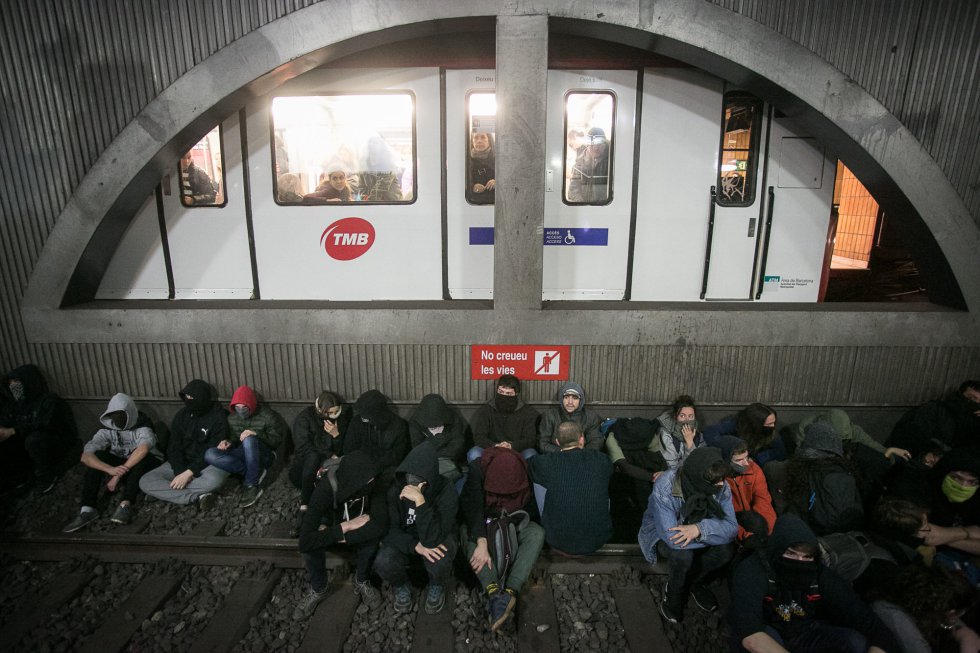
Catalonia faces on Thursday a new general strike of marked political character, this time as a protest against the trial of the leaders of the procés. The strike has been called by the minority union CSC and does not have the support of the main trade unions, although it does have the support of several pro-independence entities and the Catalan government. Despite the Government's calls for "permanent mobilization" only 23.6% of the workers of the Generalitat have stroked, according to data from the Labor Department. The public services, the big businesses and the main industries are functioning as usual this morning, but there have been traffic problems due to the cuts caused by the self-proclaimed Committees of Defense of the Republic (CDRs). The Mossos d'Esquadra have arrested four people: one in Barcelona, another in Gurb and two more in Tarragona, all for assault on authority. A student demonstration has resulted in the cutoff of the train tracks of the Plaza de Catalunya station in Barcelona.

The strike has been noticed on the roads, where the cutoffs have lasted until the early afternoon, and also in the various demonstrations organized by the students that took place in Barcelona and in the rest of the provinces. In Girona, 9,000 people protested against the Government's sub-delegation, reports Marta Rodríguez. In the Catalan capital, protesters have occupied the train tracks in Plaça Catalunya for two hours. This has forced the Generalitat to activate the Ferrocat plan for damage to the service of the Rodalies lines (Cercanías) 1, 3 and 4. In the vicinity there have been some charges of the Mossos against the demonstrators.

By midmorning, a dozen roads were cutoff. The main ones are the C-16 in Berga (Barcelona), the C-17 in Gurb (Barcelona) and the N-II in Sant Julià de Ramis (Girona). In Barcelona, several people have punctually cutoff the Gran Vía at the height of La Campana and Glòries, in addition to the Avenida del Parallel. The Mossos have restored circulation in the Gran Vía and encapsulated several of the protesters. There are about a dozen points with intermittent cutoffs that affect various bus lines. Mobility in the metropolitan area of Barcelona is today 13.7% lower than that of a conventional Thursday according to the Servei Català de Trànsit.

Public transport is operating above the minimum services established by the Generalitat. The Barcelona metro network offers between 60% and 100% of its usual service. According to the minimum services decreed by the Generalitat, Rodalies and Renfe regional trains will operate today at 33% throughout the day, while Ferrocarrils de la Generalitat de Catalunya trains will do so at 50% during peak hours (from 6.30 am to 9.30 am and from 5:00 pm to 8:00 pm) and 25% the rest of the day. They are the same minimum services established for metro, bus and tram. Two main rallys were planned in Barcelona, one at midday called by the students, and another, which is expected to be massive, at six in the afternoon.

In the absence of official data from the Department of Labor, the strike has had a high following in universities (67.4%) and 28% in schools and high schools. The majority union in non-compulsory public education, Ustec, has been one of the conveners of the strike. Its spokesman, Ramon Font, has assured that the incidence "has been very high" among the teachers.

In the Vedruna Gràcia school, a private primary and secondary school chartered with the Generalitat, around 50% of the teachers and 50% of the students who have the right to strike (from the third year of ESO) seconded the strike, according to a worker. The minimum services are functioning as usual and no incident has occurred, this employee has indicated. In the Rius i Taulet public elementary school, only 11 of the 30 teachers seconded the strike.

In the universities, the strike has also been especially noticed. Convened by the ‘Unis per la Republica’ platform, which brings together several pro-independence groups of students, the students have emptied their classrooms in numerous faculties. At the University of Girona the adherence has been massive, as reported by the institution. In the Polytechnic University of Catalonia, where the strikes do not usually have a follow-up as high as in other institutions, there was "less presence than normal" in the classes, said a spokeswoman. "Only incidents in the first hour in the Faculty of Industrial Engineering by cutting off access to the classrooms", she added. At the University of Barcelona, the strikers have also been the majority. "In many cases classes have not been taught and in some specific schools, such as Economics or Earth Sciences, classes have been maintained at a 50% rate", a spokeswoman confirmed.


Little impact in health centers


In health centers, on the other hand, the strike has barely been noticed. The main hospitals in Barcelona, such as Vall d'Hebron, the Clínic or the Hospital del Mar, have not even had to reschedule activity, a measure that is usually taken on strike days to avoid the absence of personnel. Neither in the Josep Trueta of Girona there have been incidents and the activity has developed in a normal way. A spokeswoman for the Emergency Medical System has also indicated that all units are operational and that no relevant incident has occurred, reports Jessica Mouzo.

Some of the main industrial plants in Catalonia, such as Seat in Martorell (Barcelona) or the Nissan plant in the Zona Franca, operate normally despite the strike, reports Dani Cordero. The shops in the center of Barcelona have opened their doors as a normal day, informs Grego Casanova.

The strike has been possible thanks to the call of the union Intersindical-CSC, which groups only 321 of the 50,000 union representatives in Catalonia, but has the support of pro-independence organizations, minority unions and of the Generalitat itself, which has cancelled all the public activities of its ministers to encourage the mobilization. The big unions, CC OO and UGT, do not support this strike.


Following of the strike


In the afternoon, the Department of Labor has confirmed an unequal following of the strike in the different sectors:

Transport of travelers. The strike of transport workers has represented 12.15% in the metro, 4.2% in buses, 8.08% in the Ferrocarrils de la Generalitat, 2.83% in Renfe trains. In the offices of the Autoritat Transport Metropolità (ATM) of Barcelona, the following was 67.86%.

Teaching. The strike was seconded by 27.87% of the workers.

Universities. The strike was supported by 67.45% of students.

Health. Only 7.52% of the staff went on strike.

Commerce. The strike was supported by 30% of workers in the sector.

Public administration. Despite the Government's encouragement to strike, it was only seconded by 23.66% of public workers.

In the official application of the call for the strike, Intersindical-CSC alleged labor demands, such as the repeal of the labor reform or the increase in the minimum wage. But nobody is letting aside the political motivation of this strike, which the union postponed -it was originally scheduled for February 7- to coincide with the trial of the procés. In the calls to support the strike, the union calls for the defense of the right to self-determination and against the prosecution of imprisoned politicians.

Despite its small size, the Intersindical-CSC has reaped many sympathies in the pro-independence movement. The union is in the orbit of the CUP. Its general secretary, Carles Sastre, is a known ex-member of the terrorist groups EPOCA and Terra Lliure during the seventies and eighties, who was sentenced to 48 years in prison for belonging to an armed gang and for murder.

The Catalan Government actively supports the strike today. Both the president, Quim Torra, and his ministers have canceled all their public activity. The plenary session of Parliament scheduled for today was also moved to the next week; this has led to complaints from opposition parties.

In the afternoon, thousands of people attended the demonstrations organized in different Catalan cities. In Barcelona, the unitary march supported by pro-sovereignty parties and entities, in addition to the unions promoting the strike, has brought together some 40,000 people, according to the Guardia Urbana, a figure that the organizers raise to 200,000.

Another one of the most multitudinous manifestations of this day has been the one of Girona, where some 70,000 people, according to estimations of the Local Police and the Mossos d'Esquadra, have gone out to the street

https://elpais.com/ccaa/2019/02/20/catalunya/1550691312_774567.html
Share:

Highlighted

Trials of Catalan activists - the what the why and how great academic centers are unwittingly contributing to undermining a European democracy

Twelve former Catalan politicians and activists are currently facing trial before the Spanish Supreme Court for charges ranging from m...

Blog Archive